Quick Specs
Our Verdict
Strong on endurance, durability and screen quality, with an unusually rugged IP68/IP69/IP69K rating. Undermined by deliberate processor throttling that leaves it slower than cheaper phones, and by slow charging with no charger included.
Research sources
Sources recorded for this page are linked below. Reported third-party testing belongs to the original publisher; it is not testing performed by Truthful Reviews.
Our editorial process
Research method, author and affiliate-independence details
Our editorial process
Research method, author and affiliate-independence details
Prepared by our editorial team using verified source material, product research, and a British-English editorial rewrite before publication.
- We review the working bundle for product facts, comparisons, and buyer-relevant tradeoffs before publishing.
- Non-English source material is translated into British English and rewritten into our house style without carrying over publication branding.
- Affiliate links and price references are handled separately from editorial judgements and never determine the verdict.
Read our full methodology: how we review
Affiliate links never determine our verdicts. Commercial relationships are disclosed separately from the editorial assessment, and we aim to keep buyer guidance clear, specific, and evidence-based.
Pros & Cons
Pros
- Bright, well-calibrated AMOLED — 2081 cd/m² boost, 2097 cd/m² HDR
- Excellent P3 colour accuracy at Delta E 1.3
- Very strong endurance from a 7000 mAh battery
- Exceptional IP68, IP69 and IP69K durability for the price
- Attractive and grippy bio-based silicone finish by Naoto Fukasawa
- Slim and light at 7.75 mm and 192 g, with 92.5% screen-to-body
- Versatile camera system led by a 200 MP sensor
- Genuinely useful AI editing tools in the Gallery app
- Dual nano-SIM plus eSIM support
Cons
- Snapdragon 7 Gen 4 deliberately throttled — performance below cheaper rivals
- Charging is too slow, and no fast charger is supplied in Europe
- Pre-fitted screen protector is poor quality
- Fingerprint reader placed too low to reach comfortably
- Wi-Fi 6 only, no Wi-Fi 6E
- Substantial preinstalled app and game bloat
- Five years of updates trails Samsung and Google
Full Specifications
Key Features
Bright, well-calibrated AMOLED — 2081 cd/m² boost, 2097 cd/m² HDR
Excellent P3 colour accuracy at Delta E 1.3
Very strong endurance from a 7000 mAh battery
Exceptional IP68, IP69 and IP69K durability for the price
Attractive and grippy bio-based silicone finish by Naoto Fukasawa
Slim and light at 7.75 mm and 192 g, with 92.5% screen-to-body
The Realme 16 Pro+ marks the return of the company's "Plus" line, and its pitch is built on two things: a 200-megapixel camera and an enormous battery. Realme calls the concept "Portrait Master" and aims it squarely at younger buyers making content.
The result is a phone with genuine strengths in screen, endurance and durability, undermined by a processor the software deliberately holds back.
Design
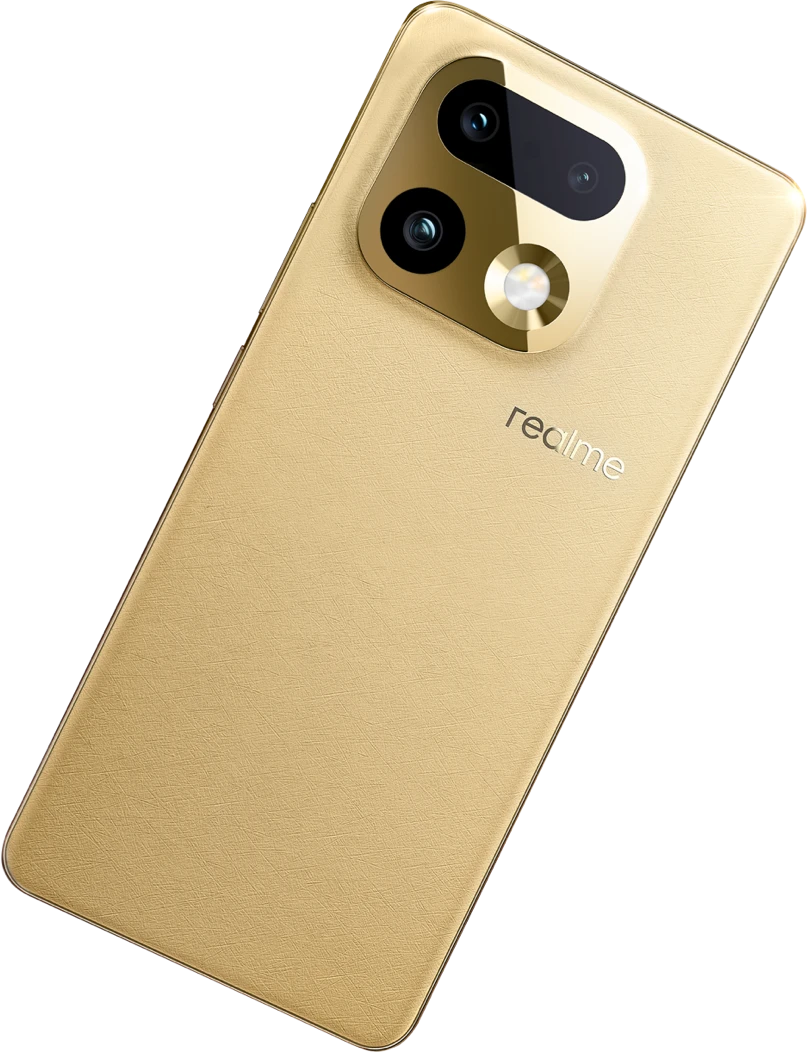
Realme has again worked with Naoto Fukasawa, the Japanese industrial designer known for an organic approach. Rather than the usual glass back — cold and slippery — the Master Gold finish uses a bio-based organic silicone, an eco-friendly faux leather whose texture takes its visual cue from wheat fields. Beyond looking good, it grips well and substantially reduces the risk of dropping the phone.
Durability is the real surprise. The chassis carries IP68, IP69 and IP69K certification, guaranteeing not only full protection against prolonged immersion but resistance to very high-pressure, high-temperature water jets. That combination is still rare at any price, let alone this one.
Despite a very large battery the proportions stay sensible: 162.5 x 76.3 x 7.75 mm and 192 g, with a screen-to-body ratio of 92.5 per cent — evidence of genuinely good bezel work.
Power and volume buttons fall naturally under the thumb with a firm, reassuring click. The optical under-display fingerprint reader does not: it sits far too low, forcing an awkward stretch every time.
The lower tray takes two physical nano-SIMs, and eSIM is supported. A screen protector comes pre-fitted, which is welcome in principle — though the one on the review unit arrived with large bubbles already in it, which is presumably why the source lists protector quality as a weakness.
Display
The panel is a 6.8in curved AMOLED at 381 ppi, with the deep blacks and effectively infinite contrast the technology implies. Gamma measures an ideal 2.2.
Brightness is a strength. Standard peak measured 580 cd/m², rising to 2,081 cd/m² when the boost mode engages under strong ambient light. HDR content peaks at 2,097 cd/m². In darkness it drops to 1.8 cd/m², which is genuinely easy on the eyes at night.
The default profile targets P3 and covers 95 per cent of it, with an excellent Delta E of 1.3. sRGB coverage is 99.8 per cent at Delta E 2.8 — still under the threshold of 3 at which colour drift becomes visible. BT.2020 coverage is 69.4 per cent. White balance sits at 6,804 K, slightly cooler than the 6,500 K ideal.
There is a "Natural" profile aimed at sRGB, and it is worth avoiding. It improves Delta E to 1.5, but white balance falls to 6,175 K — noticeably too warm — and greyscale Delta E rises to 2.4. Keep the default and leave the white balance alone.
Performance

The processor is a Qualcomm Snapdragon 7 Gen 4, and the measured results sit low for a phone at this price. Geekbench 6 returned 1,312 single-core and 4,079 multi-core, with a Geekbench GPU score of 7,048. AnTuTu 11 reached 1,380,705. All of those are somewhat below what this silicon is theoretically capable of.
The explanation appears to be deliberate. Realme's software caps processor frequencies to control heat and extend battery life. For browsing, messaging and everyday apps the limitation is invisible and the phone stays fluid. In demanding 3D games it shows quickly, and reducing graphical detail is often necessary to hold a stable frame rate. The cooling system does its job — the phone runs cool even under load — but that comes at the cost of available compute.
One further omission: the phone supports only Wi-Fi 6, where Wi-Fi 6E would be reasonable at this level.
Software
Realme UI 7.0 runs on Android 16, organised much like Oppo's ColorOS. Navigation is fluid, and the "Flux Engine" handles transition animations well enough to mask the processor's limits. Customisation is extensive, including Flux Theme 2.0 with depth-aware dynamic wallpapers.
The drawback is the amount of preinstalled software. Out of the box the phone carries a considerable number of partner applications and games. They can be uninstalled manually, but their presence needlessly bloats the system to begin with.
AI features are concentrated in the Gallery app and are more useful than most: AI Eraser removes background elements, AI Unblur sharpens soft images, AI Edit Genie performs edits from typed instructions using Google technology, and Glare Remover tames excessive light sources. Results are generally convincing.
Support runs to five years of Android updates and six years of security patches. That is around the market average now, and behind what Samsung and Google offer.
Battery

The headline feature is a 7,000 mAh silicon-chemistry battery, and endurance is genuinely solid — one of the phone's clearest strengths.
Charging is the weak point. The source lists it plainly as too slow, and in Europe the fast charger is no longer supplied in the box. That is defensible environmentally, but it does add cost for anyone who does not already own a suitable charger.
UK price and availability
In the UK the Realme 16 Pro+ is listed on Amazon UK in the 12GB/512GB configuration — the only configuration Realme produces — and is in stock at the time of writing, under model number RMX5131.
One caveat worth knowing: the UK listing is a European import (its colour is named in Italian and the model code carries an EU suffix) rather than a UK-specific SKU. Check the supplied plug and warranty terms before ordering.
Verdict
The Realme 16 Pro+ does several things genuinely well. The AMOLED screen is bright and accurately calibrated, battery life is strong, the camera setup is versatile, and the IP68/IP69/IP69K durability rating is exceptional at this price. The Fukasawa-designed finish is both attractive and practical.
What holds it back is the gap between specification and delivery. The Snapdragon 7 Gen 4 is capable silicon that Realme has chosen to restrain, so a phone at this price performs below phones that cost less. Charging is slow, the supplied screen protector is poor, and the fingerprint reader is badly placed.
If you want endurance, durability and a good screen, it earns its place. If you play demanding games, the deliberate throttling makes it the wrong choice regardless of what the chip is nominally capable of.
Ready to Purchase?
Check current prices and availability
Affiliate Disclosure: As an Amazon Associate I earn from qualifying purchases. Truthful Reviews may receive a commission when you buy through eligible Amazon UK or Amazon US links, at no extra cost to you. Affiliate partnerships never determine our verdicts or recommendations.