On hot days the desire for cold drinks rises — and with it the demand for ice. The freezer tray rarely delivers: already empty, not yet frozen, or lost somewhere between the ice cream and the barbecue supplies. Ice cube machines promise fresh ice at the press of a button within minutes. Where German brands like Gastroback, Caso and Klamer once led this market, countless models from unknown Chinese brands now dominate online retail, and at first glance they barely differ: same shape, similar functions, comparable promises. A group test of eight machines sorts the ones that do the job from the ones that quickly reach their limits.
How These Machines Actually Work
Three facts frame every purchase. First, the speed comes from chilled metal pins on which water freezes directly — producing, strictly speaking, hollow cones rather than cubes. Second, that short freezing time leaves the ice far warmer than freezer ice: hovering around the freezing point instead of minus eighteen degrees, it melts noticeably faster. Third, no machine in this class actively cools its storage container. The first cubes therefore shrink quickly, and only once the container fills does the accumulated mass help the ice keep itself cold.
Best Overall and Value Champion: WIE Ice Cube Machine
The WIE machine took the overall win and the price-performance award simultaneously, with a combination of speed, low consumption and simple operation that no other model in the field matched. The pace is the headline: many machines promise ice in five to eight minutes, and the WIE delivered its first batch in a measured 6 minutes 43 seconds, at the head of the field. It is frugal with it, drawing just 9 watt-hours for that first load.
The first cubes come out very small, but they grow with every cycle while the pace stays constant, so the machine passes 50 cubes in around 40 minutes. Operation is uncomplicated, indicator lights cover the water level and the ice container, and a self-cleaning function eases maintenance. Its compact dimensions mean it fits a kitchen worktop or a small balcony without trouble.
The one genuine weakness is noise: at 63 decibels it runs somewhat louder than its German rivals. Anyone who can live with that gets a fast, frugal and surprisingly cheap ice maker that earned its win. Search Amazon UK · Amazon US
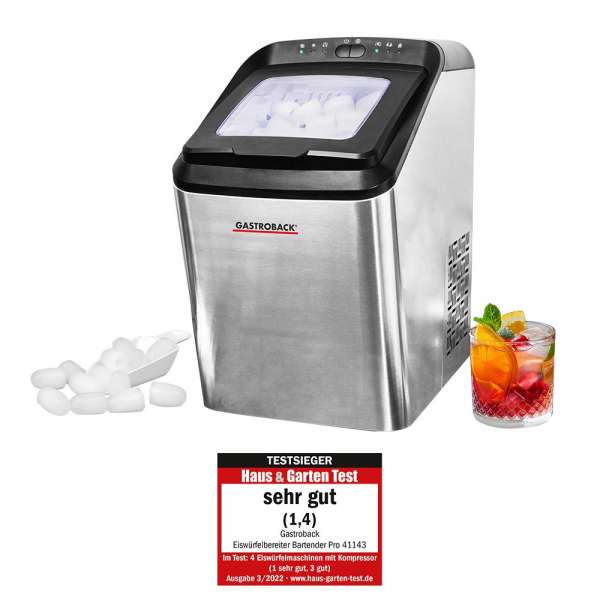
For Big Parties: Gastroback Bartender Pro
Anyone who regularly needs larger quantities of ice is well served here. The 2.8-litre water tank and 1.5-kilogram collecting container are the largest volumes in the field, which noticeably reduces refilling and emptying — an advantage in continuous use, and a real one, because every machine in this test signals an empty tank or a full container by indicator light alone. Not one offers an audible alert.
Performance convinces too: 56 cubes in around 51 minutes, with the first load barely melted by the time the second was ready, which not every machine here managed. Operation looks complex at first but proves largely intuitive after a short period of familiarisation. The stainless-steel housing needs care, while inside, an automatic cleaning function eases maintenance. One thing to know before the first use: the machine should stand upright for at least 24 hours so the coolant can distribute evenly. Search Amazon UK · Amazon US
Fast and Frugal: Caso Ice Master Pro
Third place goes to the Caso Ice Master Pro, above all for its low power consumption and quick ice production. On the first run the first cubes drop into the container after 8 minutes 15 seconds; over the following cycles they grow slightly in size and the machine settles into a constant production time of about nine minutes per round.
Operation is deliberately pared back — an on/off switch and a button to choose the cube size, and nothing more. A self-cleaning function is apparently absent too. Instead the advice is to clean the machine regularly with mild washing-up liquid and to descale it, which the convoluted internal construction can make something of a chore. Anyone wanting to reduce that workload is well advised to use filtered water. The housing combines stainless steel and plastic: the metal feels high quality, but the viewing window, already scratched on unpacking, does not make a good first impression. Search Amazon UK · Amazon US
Ten Cubes a Cycle: Klamer Ice Maker
The Klamer sits in the upper midfield on a solid range of functions. A 2.1-litre tank and 600-gram ice container are adequately sized for everyday use and smaller occasions. Its party trick is throughput: at 47 minutes 54 seconds for 50 cubes it is the fastest machine in the test, though mainly because it is the only model that produces ten cubes per cycle and so reaches the target in just five rounds. The time per individual round, at just under ten minutes, is merely average. It also offers more functions than most rivals, including a timer and a delayed-start option, while staying simple to operate.
The build is where it slips. The stainless-steel look makes a good first impression, but the brand lettering peels off after a short time, the viewing window is already heavily scratched on unpacking, and both the short 118 cm mains cable and a slight wobble count against it in handling. Search Amazon UK · Amazon US
The Discounter Entry: Silvercrest from Lidl
The Silvercrest is the cheapest model in the test and still finishes among its strongest performers. The low entry price shows mainly in the material choice and finish: the housing is entirely plastic and the push buttons feel functional rather than high quality. The upside of that construction is that the surface wipes clean easily, and inside, an automatic cleaning function helps further.
Handling earns points as well. The detailed manual eases setup — and reading it is essential, because most of the control runs through the start button, where the length of the press selects the function: four seconds to change the cube size, ten seconds for cleaning. That is not intuitive, but it is manageable after a short while. The equipment figures are respectable too, with a 2.1-litre tank and a container holding up to 800 grams of ice. Production time varies slightly from cycle to cycle, and overall the machine manages 56 cubes in just under 59 minutes — a good result at this price.
Clear Ice, Only Partly: Medion MD 11950
Medion promises crystal-clear cubes, which form when water freezes particularly slowly and evenly without trapping air bubbles. The practical check shows it is not as easy as it sounds: only some of the cubes from the machine are genuinely clear, and the rest stay milky and cloudy as in most machines.
Consumption and speed are weak points too. The first portion needs almost twelve minutes and 22 watt-hours — the Caso manages on half that — after which production settles at about ten minutes per round, for 56 cubes in 52 minutes 11 seconds. By that point the cubes from the first cycle have almost completely melted. On the positive side, the silver stainless-steel-look design with a display makes the machine feel more upmarket than many rivals. Less successful is the self-cleaning button, which is not identifiable as such at first glance, and there is no complete manual: a short guide with a hidden QR code means important instructions, cleaning among them, are only available online. Search Amazon UK · Amazon US
Smallest in the Test: Solis Ice Cube Express
The Solis is the smallest machine here and suits daily use in a small household; for larger gatherings the capacity is barely enough. A one-litre tank and a 300-gram container are clearly below the rest of the field, which costs it in the scoring, since refilling and emptying come round more often.
Operation is solid nonetheless: 56 cubes in around 66 minutes, with cubes that start very small, grow somewhat over several runs and then stay stable. Despite the plastic housing the machine feels more valuable than the cheaper Lidl model, though it stands a little unsteadily. Control is largely self-explanatory, with only the cube-size symbol causing initial confusion, and the self-cleaning function is activated by holding down the power button. Search Amazon UK · Amazon US
The Lookalikes: Euhomy and Silonn
These two finish close together, which is hardly a surprise: they resemble each other not only visually but in equipment, performance and result. Both use a 1.25-litre tank and a 300-gram container, both have a self-cleaning function, and both produce their first cubes after a little over eight minutes. There is barely any difference in power consumption either, and both work comparatively economically.
They also share their biggest weakness — volume. At 68 dB(A) for the Euhomy and 64 dB(A) for the Silonn they are among the loudest machines in the test. On top of that, the two cube sizes on offer barely differ in practice. The overall finish, though, is decent. Anyone who wants the cheapest possible way into ice machines and is not bothered by an audible background hum gets a solid everyday device from either. Search Amazon UK · Amazon US · Search Amazon UK · Amazon US
German Brands or Online Newcomers?
The market's central question gets a measured answer. At their core many of these machines are alike: two selectable cube sizes, an ice scoop and a self-cleaning function are standard equipment across the field, so what separated them was capacity, comfort and production speed. The established manufacturers now face competition above all from no-name devices by Chinese makers, which make their case chiefly on price — and the overall winner, WIE, is not one of the established German names.
That does not mean the lookalikes are interchangeable. The Euhomy, Fohere, Silonn and Ecozy machines look alike and score alike, earning points for quick production times and losing them for small tank and container capacity, and two of them are the loudest devices in the test. The established names defend themselves on their own ground: the Gastroback on tank and container volume with short production times, the Caso on short cycles and low consumption, the Klamer on constant cycles — though the Klamer's cubes are on the small side and melt quickly. The Lidl machine, meanwhile, wins on simple operation, an adequate tank and solid performance.
Running Costs and Noise
Consumption differences are real and measurable. The winner's 9 watt-hours for a first batch is the benchmark; the Medion needed 22 watt-hours for its first portion, roughly double what the Caso draws for the same job. Over a summer of daily production that gap compounds.
Noise separates the field as well. Every machine here works without being disruptive, but the differences matter to anyone running one in a living room or on a terrace. The WIE's 63 decibels make it somewhat louder than the German machines, and the Euhomy and Silonn are louder still at 68 and 64 dB(A).
Care and Maintenance
Whatever the brand, the rules are the same. Clean regularly with mild washing-up liquid and descale, and use filtered water if you want to cut that workload down, because it is the descaling that takes the time. A convoluted interior makes hand-cleaning harder, which is why an automatic or self-cleaning programme is worth having: the WIE, the Gastroback, the Silvercrest, the Solis, the Euhomy and the Silonn all have one, while the Caso apparently does not. And on the Gastroback, remember the pre-flight ritual — 24 hours standing upright before the first use, so the coolant settles.
Using the Ice
Plan around the ice's impatience rather than fighting it. Because the cubes sit near the freezing point rather than at minus eighteen, they melt considerably faster than freezer ice, and because the storage container is not cooled, the first cubes lose size until enough of them accumulate to keep each other cold. That is why the machines are best understood as a practical alternative to the freezer compartment for anyone who regularly drinks chilled in summer or often has guests — with the side benefit of freeing up freezer space for ice cream and other supplies.
What the Comparison Looked At
Every machine faced an identical, fair practical test. Equipment scoring turned mainly on size — how much water the machine holds, how many cubes it can store and how much ice it produces per day — along with the choice of cube sizes that many models offer, and smaller details from housing material and finish to cable storage and accessories such as an ice scoop. One practical detail was missing throughout: not one test device has an audible signal for missing water or a full container.
Handling was judged from the manual onwards: whether it is comprehensibly written and gives clear cleaning instructions, whether functions can be carried out intuitively or demand constant re-reading, and how much effort the machine takes to clean once the last drink is served. The technical examination measured the energy used per load and for producing at least 50 cubes, timing each under realistic conditions at room temperature, and recorded noise levels alongside.