A lawn spreader exists to do one thing properly: put fertiliser, grass seed or winter grit onto the ground evenly, in a measured quantity, without you flinging it by hand and hoping. Do it well and the lawn comes up an even green with dense germination, and paths and drives are covered consistently. Do it badly and you get stripes, bare patches and half the material in one corner. Seventeen hand-pushed spreaders were tested, and the differences between them decide whether the job goes smoothly or turns into an afternoon of fighting a wobbly plastic trolley.
What follows is recorded testing, translated. Nobody at Truthful Reviews has pushed any of these across a lawn.
Drop spreader or broadcast spreader
Almost every spreader bought for a private garden is pushed by hand. (Trailed machines for tractors, lorries and ride-on mowers are a separate category and are not covered here.) Within the hand-pushed group there are two working principles, and choosing the wrong one is the most common mistake.
A drop spreader is the recommendation for spreading fertiliser, lime and sand evenly and precisely on a lawn. Working widths run between 40 and 45 cm, which suits small and medium areas: through a narrow gateway or round an awkwardly shaped garden, the machines are light and easy to steer. Inside, the material slides out of the hopper onto a rotating roller that is driven from the wheels through an axle. The turning roller picks the granulate off the base of the hopper at a steady rate and, at the same time, distributes it across the full working width. Everything lands directly beneath the machine, which is exactly what you want when the material is expensive and the lawn edge is a flowerbed.
A broadcast spreader is the recommendation for putting down winter grit — road salt, chippings — and pelleted fertiliser efficiently, and it is the type to use on large areas where a lot of material has to go down quickly. Material drops from the hopper onto a rotating plate driven from the wheel axle, and centrifugal force throws it out sideways. Because the spinning plate sits high up, the material never touches wet snow or a soaking lawn on its way out, so it does not clump at the discharge opening. The throw width is regulated by nothing more sophisticated than how fast you walk.
Battery-driven broadcast spreaders now exist as well, and one of them was in this test. On these the plate is turned by an electric motor rather than by an axle gearbox as you push. The only identifiable advantage is that the quantity and the throw width stay constant — but they stay constant regardless of how fast you are walking, which is not what you want unless your pace never varies. A manual spreader corrects its own output automatically according to speed. Beyond that, battery spreaders are expensive, heavy, dependent on a charged battery, sometimes awkward to operate, and more prone to going wrong because of the extra mechanics and electronics.
Getting the quantity right
Dosing has to suit the job. Spreading grit, sand or road salt on a path can be judged perfectly well by eye. Fertiliser and grass seed cannot: those need a quantity you have actually set, and the recommended rate is normally printed in grams per square metre on the packaging.
There is a simple way to match the machine to the material rather than guessing at the dial:
- Mark out a square one metre by one metre on a flat, smooth surface. Lay a plastic sheet down first if you want to keep the surface clean.
- Set the dosing screw or the quantity lever to its middle position.
- Fill the spreader and run it across the test square as you would across the lawn.
- Sweep up what landed inside the square and weigh it on a kitchen scale.
- Move the quantity lever and repeat until the weight you collect matches the recommended rate for one square metre.
Keeping one alive
Spreaders are cheap to look after and easy to ruin. Salts react chemically with the metal parts, which shortens the machine's life considerably, so the routine matters most after spreading artificial fertiliser or road salt.
Brush the machine out after every use, the outlet especially, because mechanically clearing the residue is what keeps the rotating roller and the perforated dosing plate moving. Then rinse it through with a hose or a watering can: flushing lifts even the smallest particles out of slots and grooves. Let it dry in the open air afterwards. Store it out of direct sunlight — UV drives the plasticisers out of the plastic over time, and the moulded hoppers gradually turn brittle.
The picks
Top pick — Wolf-Garten WE 430
The best spreader here for fertilising. It makes an impression before you have even used it: the instructions are clear, assembly is no trouble, and the metal and plastic parts fit each other precisely. That precision makes putting the WE 430 together child's play and says a good deal about the quality of the thing.
In use it is ergonomically shaped and easy to steer. The 30 cm wheels are large, and they give the machine a constant straight run on uneven grass rather than the wandering you get from small wheels. The push frame is sturdy metal with a rubberised grip bar, which keeps contact cold off your hands in low temperatures and makes pushing pleasant.
The hopper holds 16 L, comfortably enough to fertilise a larger lawn without stopping to refill. The effective spread width of 43 cm sits in the middle of the range. Filling it is easy because it stands stably on two wide support brackets while you pour.
Its distinguishing feature is the dosing. Almost no other spreader lets you match the delivery to the material this exactly. Before first use the middle position of the outlet aperture is set with a nut, after which the outlet under the hopper opens precisely as far as the rotary control says it should. In practice the delivery is first-rate and evenly metered — fertiliser, sand or grit alike — thanks to that adjustable discharge and a studded roller that spreads fine-grained material accurately, quickly and without much effort.
No real drawback emerged. The only reason to look elsewhere is if you do not want to assemble a machine from parts, and even that assembly is straightforward.
Search Amazon UK · Search Amazon US
Best for large lawns — Gardena Spreader XL
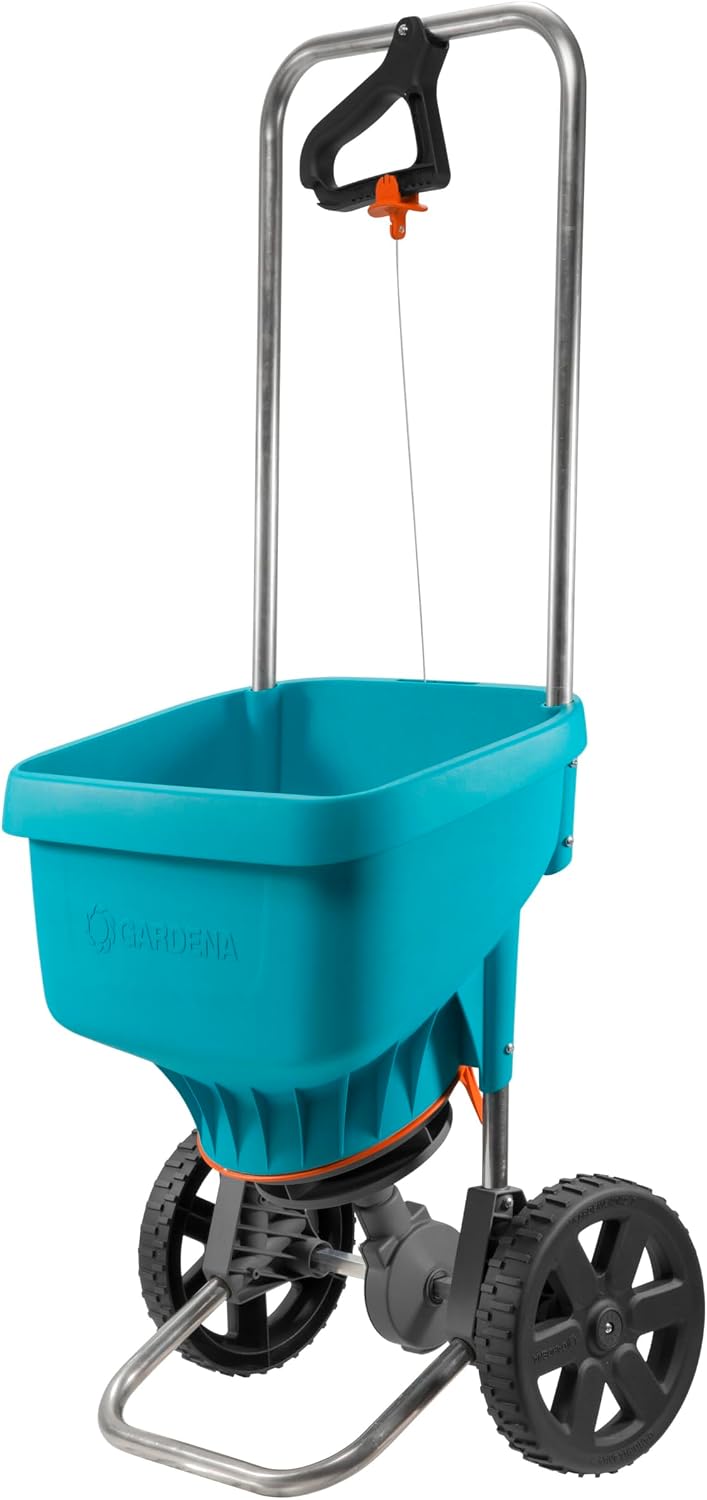
A powerful broadcast spreader for medium and large areas. It starts collecting points at setup: assembly is a few movements, bolt the handle frame to the body, connect the cable to the grip, and it is ready. At around 4 kg it stands stably on a wide metal frame, firm and secure enough that it can be filled on uneven grass without tipping. The 22 cm wheels have an angular tread that holds and tracks properly, wet or uneven ground included.
The name is not decoration. The broadcast mechanism runs smoothly and the hopper holds 18 L, which is enough to work lawns of 1,000 square metres and more without difficulty — granulated fertiliser, sharp-edged chippings or smooth sand, it makes no difference. A mixing propeller in the base of the hopper is driven from the wheel axle as you push, and its thick rotor blades keep a steady supply going down to the spinning plate below, which is what produces an even spread.
The throw pattern is adjustable from a quarter circle to a half circle to suit the ground and the material, so wide open lawn and tight passages can each be given the right amount. That is the feature that makes the distribution notably even in practice. The quantity itself is set by a simple but functional mechanism operated from an ergonomic grip that needs very little force. Shifting between the detent steps is stiff and slightly notchy, though a measured push gets it there without any trouble.
This is the one to choose if you want a universal spreader for fertiliser, seed or salt and you want large areas done in a sensible amount of time.
Search Amazon UK · Search Amazon US
The heavy-duty option — Cemo Spreader SW 20-C
A robust broadcast spreader built for continuous work on extensive grassland, and rated the best machine encountered across this test group. It arrives largely built, in pre-assembled subassemblies, so it is ready in a few movements. The 20 L hopper is moulded in thick plastic and finished perfectly, and a removable filling sieve stops the mixer being jammed by a foreign body that fell in or came with the fertiliser. A weather hood is available separately to keep the contents dry so the material does not clump.
At just under 11 kg it is massively built and designed to last. The handle bar is weatherproof stainless tube, the body torsionally stiff plastic. The ergonomics are good too: the wide grip bar makes it easy to steer round trees or beds, and a thick rubber covering gives enough grip with wet hands.
The wheels are on the large side at 26 cm across, 8 cm wide, air-filled and mounted on a stainless steel axle. That combination tracks accurately and securely on every surface tried — paving, lawn, decorative gravel and loose soil.
It earns its keep before the work starts, because setting the throw width and the quantity is quick, simple and accurate, using a long, easily reached lever and a height-adjustable spreading hood. Out on the test area it turned out to be light in the hand: the high-quality axle gearbox and the wide, well-treaded wheels mean very little effort is needed to push it. Delivery is even and constant across different grain sizes — granulated fertiliser, sharp winter chippings or fine lawn sand all came out consistently.
The catch is what you pay and what you carry. It costs a multiple of the top pick, which is why it makes sense mainly for commercial use and for private households with a great deal of ground, and it is heavy.
Search Amazon UK · Search Amazon US
The compact drop spreader — Gardena Spreader L
A handy fertilising machine with a 45 cm spread width and over 12 L of capacity, which made for comfortable working in the practical test. Compact dimensions and even distribution are its selling points, along with a strong showing for what it costs relative to the rest of the field.
Filling calls for a little care: the support foot is short, so on uneven ground there is not much standing stability. Inside, the rotating roller in the hopper is fanned and covered by a spreading disc — the disc gives an even intake, and the roller underneath delivers consistently.
Stored away it is unusually tidy, taking up a footprint of 25 x 60 cm.
Search Amazon UK · Search Amazon US
Also tested
Wolf Garten WE 330 — a thoroughly stable drop spreader with a spread width of around 40 cm and a 15-litre hopper, which suits small and medium gardens; assembly is easy, the parts are well finished and precisely made, quantity is set on a detented slider with defined stops, and the 17 cm free-running wheels and sturdy handle bar keep the 3.4 kg machine tracking accurately, though its small angular outlet openings pass chippings, salt and sand poorly. Search Amazon UK · Search Amazon US
Substral EvenGreen box spreader — detail quality is patchy in places but the machine convinced in practice: the hopper is big enough, two metal spars keep it standing stably on the lawn while it is filled, the discharge quantity is set precisely on a knurled nut with a sight window, and a working width of around 45 cm on huge plastic wheels makes fertilising and sanding pleasantly quick; the wobbly dosing grip on the spar is the irritation. Search Amazon UK · Search Amazon US
Siena Garden Spreader Comfort 12L — a drop spreader with a comfortable 45 cm working width, weighing only 2.5 kg and arriving almost fully assembled with tool-free push-fit connections; the material is decent quality though the fit of some parts is not, the side detent slider doses even mineral fertilisers accurately, and the real complaint is the narrow handgrip, which makes a wide machine awkward to steer round tight corners and through gaps. Search Amazon UK · Search Amazon US
Freund Victoria Spreader 10 L — an inexpensive 2.4 kg drop spreader with a 45 cm working width and a 10 L hopper for small and medium lawns; assembly is tool-free and quick, three handle rods pushed together, and the material and finish are faultless, with tray, tyres and slider precisely deburred, plastic thick and stable and a smooth surface that resists sticking; the outlets sit close to the ground, so it is best kept to granulated fertiliser, sand and lime rather than winter salt, which damp can block them with, and its weak points are a narrow hand rest on a thin spar that makes turning awkward and a very unstable stance that needs care during filling. Search Amazon UK · Search Amazon US
Einhell GC-SR 12 — an inexpensive machine offering the basic functions for fertiliser, sand or lime, with the discharge quantity set on a lever behind the roughly 12 L hopper, which narrows towards the ground into a slim slot; the low outlet height means it is not the one for damp grass or snow, where salt or fertiliser clumps quickly, and against what it costs the performance is acceptable. Search Amazon UK · Search Amazon US
Hecht 220 fertiliser spreader — the wobbler of the group: a 45 cm spread width and a 20 L hopper mean large areas can be covered efficiently, but the distance between the support spar and the wheel axle is too short and it tipped over constantly while being filled with granulated fertiliser, the construction is rickety, the plastic hopper thin, and the narrow handle bar makes a 60 cm wide machine awkward to guide. Search Amazon UK · Search Amazon US
Einhell GE-SR 18/22 — a bulky battery broadcast spreader, 114 cm tall and 6.4 kg, with a generous 22 L hopper whose plate is turned by an electric motor running off the manufacturer's battery platform; a four-amp-hour battery ran it for up to eight hours, but the motor drives only the plate while the wheels are still pushed by hand, and without a battery the machine cannot be used at all; assembly is the low point, with wheels and handle spar arriving as many small parts and instructions short on information and illustrations, and in use the stiff pistol grip and a jamming quantity slider make it hard to match the output to your walking pace. It is also supplied without battery or charger. Search Amazon UK · Search Amazon US
Substral EasyGreen universal broadcast spreader — a compact 2.6 kg machine delivered fully assembled: fold the guide spar up, tighten the wing nuts, done; at 33 cm wide with a 12 L hopper it is one of the small broadcast spreaders, and while operation is simple and the dosing accurate, the low weight and a track of only 26 cm give it a wobbly stance, a rickety support stand leaves it leaning badly when parked, the plastic is largely sharp-edged with several screws already rusted, and the rotation mixer in the tray is so flat and narrow that it does not always pick up fine-grained or damp material, causing occasional dropouts in delivery. Search Amazon UK · Search Amazon US
Hecht Universal Spreader 270 — a 4.4 kg broadcast machine for fertiliser, chippings and salt that begins with a laborious build, since it arrives in countless individual parts and even the wheels with their gearbox and axle have to be assembled, with foreign-language instructions, tiny pictures and missing information making it worse; once running, the sight window for the quantity setting is barely readable through a blind plastic pane, rolling resistance is relatively high despite 22 cm wide wheels, the finish is poor with ragged, sharp-edged openings in the tray floor, and the test ended abruptly when the Bowden cable at the dosing plate tore. This one is best left alone. Search Amazon UK · Search Amazon US
Tectake spreader — a classic broadcast spreader that has to be built from scratch, and the poor instructions, moderate finish, improvable mechanism and loose component fit turn that into a long job; afterwards the rickety construction and short wheel spacing give it poor tracking, and the outlet openings in the hopper floor had to be re-cut with a knife to remove sharp-edged material left by bad punching. The one positive is the relatively large throw width the rotating plate produces, though there is no provision at all for adjusting the throw direction or width. Search Amazon UK · Search Amazon US
VidaXL Spreader PVC Steel — identical in construction to another badged model, differing only in the colour of the hopper and the instructions supplied, and those instructions are barely legible, with minute type and poor pictures offering no help, which makes assembly close to impossible; the finish and fit are poor, and in testing the quantity adjustment jammed, the wheels turned stiffly and the output was uneven. Search Amazon UK · Search Amazon US
How they were assessed
Seventeen hand-pushed spreaders were compared, on the basis that hand-pushed machines are inexpensive, effective and simple to use. Each had to prove itself spreading road salt, quartz sand, lava chippings and fertiliser, working on paving or on grass depending on the material. The areas used were driveways of around 60 m² and a conventional garden with a net lawn area of just under 300 m², with fertiliser going down at an average of about 40 grams per square metre.
Assembly, handling, adjustment options and material and finish quality were all assessed. Is the hopper big enough? Does the machine stand securely and without tipping while it is being filled? Can the delivery be dosed accurately? Ergonomics were assessed as well, with two people of different build and height using each machine so that the effort required and the comfort of operation could be judged rather than assumed.
The short answers
Which lawn spreader is the best? The Wolf-Garten WE 430. It offers more adjustment than anything else here, a stable construction and excellent handling.
What types of lawn spreader are there? Two working principles are used for spreading material over a large area. Drop spreaders are the right choice for fertilising a lawn in finely measured quantities. Broadcast spreaders are the ones to have for putting down winter grit and pelleted fertiliser quickly.
What do I actually need one for? Spreading fertiliser, winter grit and grass seed evenly over a large area — in gardens, and on paths and open surfaces.
Is a battery spreader worth it? On this evidence, no. The plate speed stays constant regardless of your walking pace, which is a drawback rather than a benefit unless you walk at an unvarying speed, and a manual machine adjusts its output to speed by itself.