Correction data, apps and running costs
Machines for larger areas often add satellite navigation on top. To avoid an RTK aerial altogether, the newest models pull correction data from the internet, which needs a GNSS module and a connection — usually a mobile SIM in the housing, with the data cost folded into the purchase and advertised as a permanent free extra.
Remote access is a separate matter. Starting, stopping or programming the mower from outside your own network is often tied to a subscription from the outset, with one to three years given away as a sweetener; after that you pay or lose remote access, while network correction data is promised to stay active. Choosing carefully limits the risk of unplanned extras: pure laser and camera machines do not depend on satellite signals at all, some cloud-corrected models can be fed by a local aerial instead, and essentially all of them can be driven over Bluetooth and a home wireless network without mobile coverage.
Only the cheapest machines are still operated solely by crouching down and pressing buttons. Most models must be set up through an app and a manufacturer cloud account, and that is where scheduling, zone management and fault reporting live. More and more apps offer automapping, where the machine learns the outline on its own reconnaissance run using camera image analysis. That works only on areas which stand out optically from everything on and around them; in wilder gardens the difference between grass, beds, sunken stone and pond margins is hard for a camera to read, and the machine maps inaccurately or gets stuck. It also registers only one connected area, so anything separated by a path still has to be taught by hand — which is why most machines with automapping also offer manual mapping.
Edges, corridors, slopes and area
A robot can only cut a boundary exactly when the adjoining surface is flush with the lawn. Driving along a wall, a centrally mounted deck cannot reach the strip at the edge, and tall grass stays standing. Newer machines shorten that gap by swinging the blade disc outwards on boundary runs, by mounting a second disc at the rear, or by providing a side socket for an extra disc or a rotating-line trimmer.
Corridors linking two areas are the other problem zone. Gaps under a metre wide still defeat many machines, though smarter camera analysis has made them braver and some now pass through 70 cm or less. Where the data sheet is silent on this, it is a poor sign for a complicated garden.
Battery capacity and charging speed decide how much ground is covered in a day or two, and manufacturers usually put the figure in the model name. The quoted range spans 250 to 10,000 square metres and is calculated under ideal conditions, so a garden that forces constant avoiding manoeuvres falls short of it. Some manufacturers enforce the limit in software, and the app will abandon a mapping run that exceeds it.
A strong, high-voltage battery also helps on slopes. Where 35 % was once the usual ceiling, about 50 % is now standard, and heavily motorised all-wheel models with a motor on each of three or four wheels have pushed advertised figures as high as 80 %. That power costs more, the machines are bulky and heavy, and tearing out tufts in sharp turns on damp ground is part of the bargain. Some newer all-wheel machines have actively steered rollers so they move sideways with less friction instead of scrubbing across the turf.
The picks
Top pick — Segway Navimow i215 Lidar
The best robot mower for most gardens. A forward-looking lidar module and a camera watch where the grass stops and whether anything is in the way, so no base station is needed in the garden or on a wall — placing the dock and plugging it in is the whole job. At 64 cm long and 45 cm wide it is one of the more compact machines. The lid carries buttons and a 2.4-inch colour display for many commands, with the full function set in the app; a PIN, mobile location and, as a rare built-in touch, Apple's Find My network over Bluetooth cover theft. A central disc with six blades does the cutting, rain sensors send it back to the dock, and the housing is sealed to IP66 so clippings can be hosed off. At 14.7 kg it is one of the lighter machines, though the thin housing edges dig into the hand and there are no grip recesses.
Automapping worked faultlessly on the test ground. As with most machines it covers only self-contained ground, so grass behind a stone path is driven to by hand and mapped as a separate zone. Rarely, the app can redraw a boundary with a swipe instead of demanding a fresh mapping run, and the software as a whole is pleasantly lean.
In practice the lack of fine tuning is not missed. It works the lawn in parallel lanes; the narrow 22 cm cut takes many passes, which is the price of so compact a body. It proved very manoeuvrable and fits through 70 cm corridors, early trouble in such passages having been cleared by a firmware update part-way through. Trees, flower islands, buckets, watering cans, hose reels, cultivators and the small dummies of the obstacle course were all passed without contact, for which the animal-friendly mode has to be switched on explicitly. Ramps over a sunken path are hauled by two strong rear wheels and a pair of front castors, sometimes only after several attempts, and raised stones on uneven paths force a detour where other machines glide over. The motors are rated to 45 %, but rough terrain is a job for a machine built for it.
Edge cutting is where to keep expectations moderate: in automapping mode the boundary is shaved inconsistently, sometimes close in, sometimes at a large distance. Manual mapping steers it nearer. A dedicated edge mode existed but was labelled a potentially buggy beta and was left out of the assessment.
Search Amazon UK · Search Amazon US
For difficult ground — Dreame A3 AWD Pro 3500
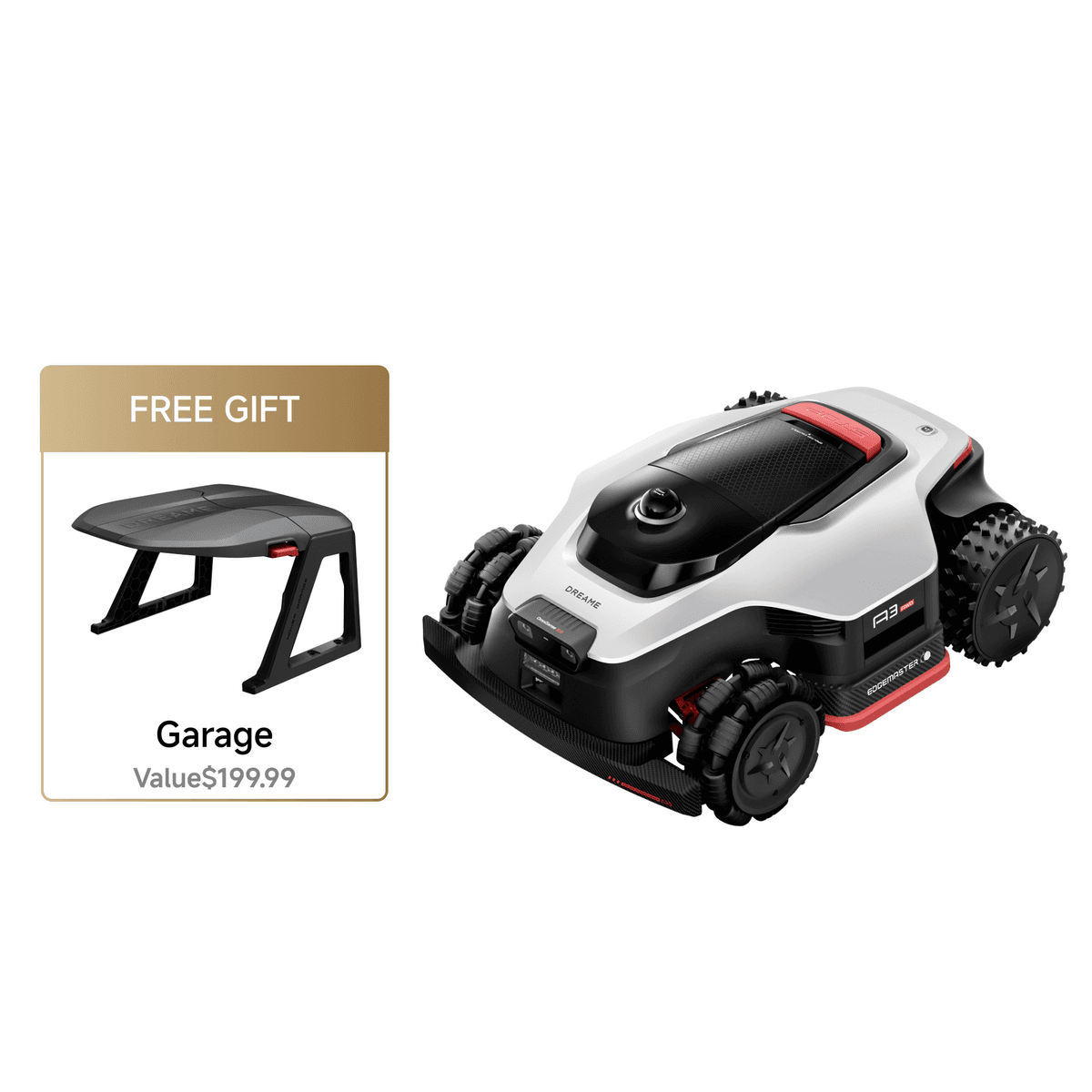
If the plot is steep drops, deep hollows and overgrown tree roots rather than an even carpet, this is the machine that is not stopped by it. Four strongly motorised wheels find a way through sloping gardens and a floating disc cuts evenly on uneven ground. On operation, obstacle detection and edge work there is little between it and the top pick; the heavy, bulky build and the higher price mark it out as a special case rather than a mass-market allrounder.
The 3500 in the name is a daily square-metre claim, though the app makes clear that careful mowing at standard pace manages 2,500. Between that battery and four motors it weighs 24 kg and is unwieldy despite two side grip recesses. A lidar dome and front camera mean nothing has to be screwed into the ground or onto a wall. Guiding it round the boundary by joystick is the better approach: the mapping automation is plainly unfinished and, let off the leash, shot over the stone edge into the bed every time, damaging delicate plants.
It mows systematically, and a generous 40 cm cut means fewer lanes. On request it swings one of its two blade plates to within 3 cm of the housing edge and catches many stalks at the boundary, though in that mode the height is fixed at 3 cm while the open area can be set from 3 to 10 cm. Where it identifies slabs beside the grass it drives on them with one side; where a sloping path lies behind the stone edge it holds back and leaves a narrow strip, which reducing the buffer in the app does not entirely train out. Ramps are taken confidently with reserves left over on the 80 % rating, and the floating deck visibly evens out ground waved by tree roots. For all its power it is quick enough to clear narrow corridors and the obstacle course without contact.
Its limit is manoeuvring room. At 74 cm long and 53 cm wide it still cannot catch every blade in an awkward nook, and multi-step turns in confined spaces pull tufts out of the ground and leave frequently driven lawn flattened.
Search Amazon UK · Search Amazon US
For clean edges — Ecovacs Goat A1600 Lidar Pro
Most robots mow the open area without gaps; if you also care about the edge, be choosier. This one carries a line-trimmer module bolted to its left flank which deals only with the boundary, at a fixed 6 cm height, while six blades on two discs underneath cut the open area from 3 to 9 cm. Fitting it is the only step that lengthens commissioning: stand the mower on end, drop the trimmer into its shaft, secure it with three screws and clip on two brush sections that shield the housing from thrown clippings. A laser dome on top plus a laser and camera at the front handle orientation, so there are no masts or ground aerials.
The app carries plenty of settings but is not consistently clear. The cutting height sits two menu levels down rather than on the main screen, and the permission that lets the mower run out onto slabs for a better edge hides under an entry whose explanatory text suggests the opposite. Odder still, the detection options ship with people-detection on and small-animal detection off; with the AI detection enabled it registers and rounds almost every obstacle, though it occasionally nudges a small dummy aside with its wing. Corridors bring awkward catching that marks the housing and the plants around it, and ramps are sometimes refused altogether or managed only with a struggle, even at half the 50 % gradient it is rated for.
The trimmer is the artistry. It is loud — the plastic line makes the noise of a hand-held trimmer, where blade-only running is as quiet as robot mowers usually are — and the module cuts out when the sensors register a person within 1.5 metres. With it active the machine follows the boundary with its trimmer side, which means anticlockwise, unusual for the type. On an automatically mapped outline it runs the line precisely along the edge over long stretches, curves included, though at some points it holds an apparently unnecessary distance. Tuning the collision setting for short grass and mapping manually with a reduced margin get it closer, but that is a balancing act: too bold and the trimmer takes the leaves off a cultivated orchid beyond the lawn edge. Get it right and hardly any current mower leaves as little hand trimming behind — provided a uniform 6 cm lawn suits you.
Search Amazon UK · Search Amazon US
The best boundary-wire machine — Worx Landroid M 700 WR142E
The pick for anyone who does not mind laying a wire. Enough ground clearance and wide tyres meant little trouble with pinch points, gradients and ramps, and it is compact and very stable, untroubled by bushes, wheelie bins and a brick castle. Its defining feature is the modular principle: a base machine you equip with the battery capacity, sensors and radio module you actually want.
The installation kit covers 700 square metres. The pegs supplied are short and unribbed, so they hold poorly in soft sand, which shows most on wavy ground. Cable aside, barely half an hour passed from unboxing to first start; it makes no boundary test run and simply begins in automatic mode, with the app needed only for mowing times and zones. Depending on the lawn you choose 20-volt batteries of two, four, five or eight amp-hours, and a removable pack is genuinely useful over winter. Options include a forward-facing ultrasonic attachment so obstacles are rounded rather than bumped, magnetic strips to fence off flower islands, a satellite and 4G module with a prepaid SIM that alerts, locks and traces if the mower leaves its geofence, and a voice-control module that answers simple spoken questions without an internet connection, which was not part of the test.
A small display and a few buttons — the stop button large enough to catch the eye — set automatic operation, the clock and the wireless connection, while the app handles fine tuning, zone management and reporting. Where areas are joined by corridors it detects them automatically and up to four zones can be set. It docks from the side because the charging contacts sit on the right, so the station takes up less room and all but disappears: its lawn-grid structure lets the turf grow through, and the grass on it still gets mown. Like almost all wire machines it drives a random zigzag, which looks like chaos and nonetheless produces a clean result — after a week every blade has been caught at least once. The noise is pleasant; from 20 metres only a gentle hum is audible.
The weaknesses are few. The short pegs can be swapped. For the app to reach the mower it has to be within wireless range, which larger gardens often make impossible, and at minimum the station needs to be in range for app comfort and automatic updates. And the accessories are expensive — a rival with ultrasonic sensors as standard costs less than this machine's base model.
Search Amazon UK · Search Amazon US
Small gardens without the outlay — Mova Viax 250
A small garden, no time to mow it and no appetite for a big outlay or for burying cable. Where many brands pitch their entry machines just under the psychological threshold, this one sits a good deal lower and still uses modern technology: a forward-facing twin camera lets it work in systematic parallel lanes for quickly visible results, rather than the time-consuming random pattern many low-priced machines are stuck with.
It is a small machine with a small disc, a small battery and adequately motorised wheels for small, ideally level areas. The maker quotes gradients of up to 40 %, but less steep ramp runs already gave trouble and it does not always climb them — sometimes it beaches itself. The daily figure is 250 square metres, doubling promised if the pace is raised in the app, though only on flat ground without trees or shrubs to wind around. Complicated shapes are no problem: front drive with a passive rear castor and a short (59 cm), narrow (38 cm) body make it exceptionally nimble.
Commissioning is simple — dock, lift the light (9.5 kg) machine into position, set it up in the app — but there is no organising it without app access and a cloud account. Boundaries have to be taught on a remote-controlled run; automatic mapping, contrary to the marketing, exists only as an error-prone beta buried deep in a menu, and the manufacturer corrected its website once this was pointed out. The app offers most of the basics: sub-zones with individual cutting angles and stamped shapes, runs restricted to the edge or to selected spots, and accessible zones that let it cross stepping stones it would otherwise avoid. The cutting height, though, is a physical dial on the lid rather than a software setting, so raising the grass remotely before a dry spell is not possible, and with no display, no PIN and satellite location only via a paid-for module, protection against theft is weak as delivered.
The camera grazes the open area without gaps but leaves the odd strip on wavy ground, which shows only at low cutting heights. From the boundary it keeps a large margin; the lane can be shifted 5, 10 or 15 cm outwards so the outer wheel runs on adjacent slabs, but the result stays inconsistent, probably because the software reads obstacles that are not there. Narrow corridors bring the same timidity, with repeated stops and refusals for no comprehensible reason. Where something genuinely is in the way, it rounds both the small dummies and garden tools reliably.
Search Amazon UK · Search Amazon US
Also tested
Segway Navimow i205 AWD — built for up to 500 square metres and surprisingly capable on rough ground, because the rear castor is motorised alongside the two front wheels. Correction data arrives over mobile by default, with the aerial only optional. Mapping is faultless and leaves a pleasingly small edge distance, but cutting height is a dial on the housing, and the front camera brakes for trees at a considerable distance while missing moving obstacles, driving over the occasional dummy at the edge or in shade. Search Amazon UK · Search Amazon US
Sunseeker S4 — designed for up to 1,000 square metres and promising allrounder qualities it does not quite reach. Self-mapping with lidar and front camera reads curved and overgrown edges almost throughout, yet it overlooked one passage that is genuinely wide enough and would not mow it even after the map was edited. Automatic mapping leaves up to 20 cm to the boundary; a floating deck evens out wavy ground; ramps are managed on a 45 % rating. Good edges need the mower to run out over flush kerbstones, the only way to bridge the 12 cm between disc and housing edge. Search Amazon UK · Search Amazon US
Worx Landroid Cloud Vision WR341E 4WD — four separately driven wheels and an actively steered front pair, rated to 84 %, and at 18 kg pleasantly light for its power. Its satellite navigation draws correction data over the home wireless network; short outages are survivable on camera vision, but a longer spell stops it. Automapping works excellently and every run passed without contact. It is too bulky for corners, though, and 13 cm sits between disc and housing edge as delivered; its 22 cm cut needs many lanes, and the front-wheel servos whirr unpleasantly. Search Amazon UK · Search Amazon US
Gardena Smart Sileno Sense 400 — for simple ornamental lawns up to 400 square metres, cutting to a maximum 45 mm, with no more than 25 % claimed. Steering it round the boundary means marking a virtual waypoint at every change of direction, and complex areas need dozens; misplace one and you start again. Cutting height means turning the machine on its back. The open lawn comes out evenly cut and pleasantly quiet, but up to 20 cm can be left at the edge, wasting an ingenious swinging rear disc that often misjudges. Its front camera rounded every small dummy without contact and even braked for them while docking. Search Amazon UK · Search Amazon US
Lymow One Plus — a tracked machine for large lawns, rated to 100 %, with two wide bar blades that lift the stalks with strong suction and produced a fine, even cut in neglected areas. A 40 cm cut and a metre per second make it very quick, but the running noise is that of an electric push mower. At 35 kg the set-up is uncomfortable and needs an RTK aerial, and it proved prone to trouble in boundary areas, under trees and while docking. Most small dummies were driven over, and a rake and a hose were flattened, which makes its twin camera, five ultrasonic and two Hall sensors worth little. Search Amazon UK · Search Amazon US
Roborock RockMow Z120 Lidar — laser navigation plus all-wheel drive, rated to 80 %, with sprung rear wheels, steerable front wheels and a floating disc. That disc is feeble for the raised chassis: 24 cm across and 14 cm in from the housing edge, reducible to 3 cm only with an optional module that was unavailable. App and firmware feel unfinished — the mapping automation is rightly labelled beta and refuses to work, a bug temporarily stopped new areas being saved, and updates repeatedly overhauled functions. It broke through boundaries on edge runs and dropped onto a sunken path behind. Search Amazon UK · Search Amazon US
Segway Navimow X420 — four motorised wheels on sprung axles, rated to 80 %, with a generous 43 cm cut. Motors and blades are louder than usual at close to 70 dB. Front wheels that turn through 90 degrees let it wriggle round chair legs, and it moves through metre-wide corridors smoothly. Its long (80 cm), wide (61 cm) body needs a lot of room, and 29 kg is potentially hard on the turf. Camera-based boundary recognition could not be relied on, while joystick-taught areas gave no trouble. There is a fuller write-up in our Segway Navimow X420 review. Search Amazon UK · Search Amazon US
Mova Lidax Ultra 1000 AWD — very nearly the same machine as the terrain pick, aimed at smaller areas, with a smaller battery bringing the price down. Its automapping stays out of the bed, but part of the housing still reaches into the flowers alongside. It proposes areas to declare as no-go zones, which is just as well: ignoring the suggestion left it circling a tree alarmingly tightly. It repeatedly drove over dummies placed in half shade, rounded a flat-laid rake only at the highest sensitivity, and got stuck in narrow corridors its sibling managed faultlessly. Search Amazon UK · Search Amazon US
Terramow V600 — orients itself purely by camera, with three optics looking forward, and was outstandingly quick to get going: docked and introduced to the app, it mows at once and takes the mapping in its stride. The automapping is exemplary reliable, it never broke into the bed, and it mows corners more thoroughly than most. There is no manual mapping, but no-go zones round trees and bare patches are created automatically and the outline updates itself every outing. Against it: nerve-shreddingly slow app performance, no display, and no capability on rough ground — uneven stone paths and ramps beach it. Search Amazon UK · Search Amazon US
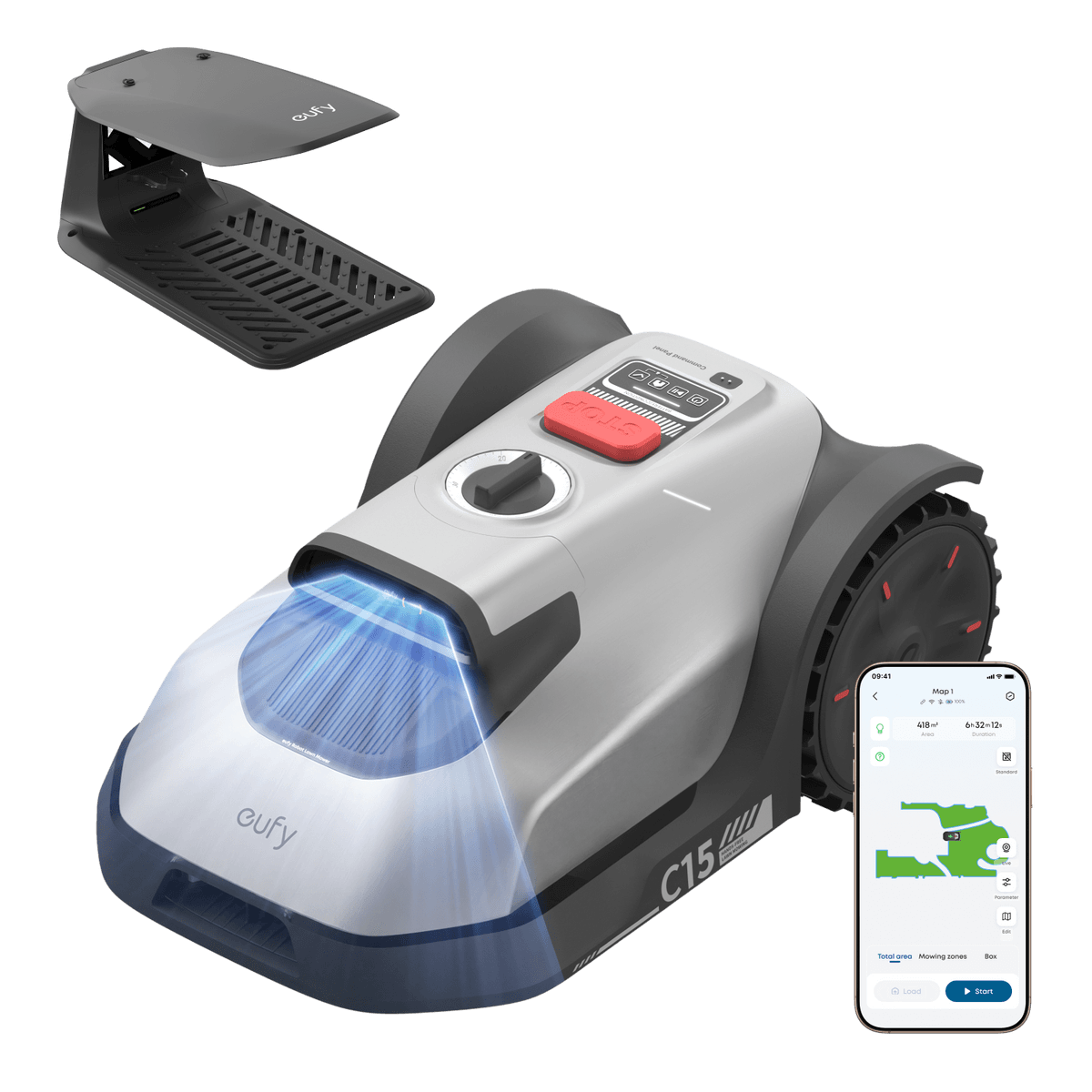
Eufy C15 — an inexpensive camera-only entry machine covering 500 square metres, with a garage roof included and neither wire nor ground aerial needed. There was no need — and no way — to intervene in mapping; the outline came out perfect and updated itself when the physical shape was altered. Its app responds noticeably faster than a closely related model's. Detection is at times over-sensitive, seeing hurdles where there are none and braking at the hard shadow of a plant, and the up-and-down of a double ramp over a sunken path defeated it entirely. Search Amazon UK · Search Amazon US
Mammotion Luba 3 AWD 3000 — a wide, bullish flagship with a 360-degree laser dome sharing route planning with a front camera and satellite navigation. It grazes the open area quickly and completely on a 40 cm cut and gets through corridors surprisingly nimbly. At the edge it loses its composure: either an over-cautious distance leaving much hand work, or a run so close that it shot over the kerbstone boundary with two wheels in the air. The advertised spontaneous-mowing function is flagged as a buggy beta in the app itself and behaved accordingly, breaking through boundaries into the flower bed. Search Amazon UK · Search Amazon US
Sunseeker V3 — for a while the pick for machines that are ready to go with almost no installation, since displaced by a cheaper one. It orients itself purely by camera, an approach with real limits since bare or patchy grass can throw it off — and of all the camera machines tested it solves precisely that problem most reliably, differentiating well between a half-grown area worth driving and one that is not. Rear wheels drive, there is a single wheel at the front, the height is manual and generous ground clearance promises few problems in small dips. It also spotted obstacles sitting higher off the ground, which few camera machines manage. Search Amazon UK · Search Amazon US
Parkside PMRDA 20-Li B2 — a wire-guided own-brand machine that was the price pick for a time, now an end-of-line model overtaken by wireless navigation. The cable is laid at 30 cm from the edge and needs care, because the app cannot set how far it may be overrun. The battery is bought separately or shared with other 20-volt tools. It roams at random, reliably enough to reach every area, and a proportion of the boundary wire can be programmed before mowing starts, which doubles as a manual edge run. Bump sensors sometimes react sluggishly; the housing leaves 3 cm of ground clearance and the tilt sensors respond well. Search Amazon UK · Search Amazon US
RoboUP T1200 Pro — the claimed area does not add up: roughly 170 square metres took 155 minutes, so 1,440 is not plausible. The data sheet is equally confused, quoting 100 minutes of continuous mowing where the run lasted 155 and still showed 32 % charge. Beyond the faulty figures it does its job and now avoids small obstacles, which is a real improvement, but the automatic mapping still achieves little, the app offers very little for the class, and it takes a very long time. Search Amazon UK · Search Amazon US
Stihl iMow 4 and iMow 3 — nothing to fault in build, which the 11 kg of the larger machine reflects. Beyond that there is little to be excited by: a wire has to be laid, the driving is random, and there are very few ways to intervene even with the app — manual height adjustment, no lane-overlap setting, no choice of one pass or two, and no indication of how long it still needs. Optical sensing is absent; sensors detect larger obstacles and reduce speed but neither stop nor drive round. The smaller model is identical bar a smaller battery and weaker charger, dropping the rated area to 500 square metres. On both, connecting the app was a recurring annoyance. Search Amazon UK · Search Amazon US
Dreame A2 — a real improvement on the brand's former winner. The app is enormously better and its map-editing options are the envy of the field. The novelty is an edge mode in which the disc slides sideways to cut within five centimetres of the boundary, which works splendidly and, unlike a second rear disc, costs no extra time. It navigates perfectly and needs nothing at installation beyond its charging station — no beacons, no cable, no aerial. It failed to register the test ball over several attempts, which is strange given that at the highest detection setting it avoids dandelions, and uneven ground is not what it was built for. Search Amazon UK · Search Amazon US
Dreame A1 — a former winner and one of the first machines to navigate largely on internal sensors alone, since overtaken but still worth buying in a clearance sale. Installation demands little and the map is shown three-dimensionally, though functions for splitting, correcting or joining zones are partly missing. Cutting height of three to seven centimetres, lane orientation, detection and timers in five-minute steps are all set in the app. Over three weeks it worked very reliably: no failures, no connection problems, no manual intervention, boundaries perfectly respected, and it stayed oriented on soft, muddy ground even as the tread clogged. Search Amazon UK · Search Amazon US
Ecovacs Goat G1 800 — needs no boundary cable but does need its own navigation beacons, which complicate installation and can be expensive, and during mapping it reports a good connection then announces a failure only after the whole boundary has been driven, without saying why. A real highlight is the usable camera on top: you can see what the mower sees, record video and watch the plot at night. The big catch is that the app allows only one lawn, which can be neither split nor extended. Over a long run it drew its lanes almost faultlessly, though plants in no-go zones are wrongly read as obstacles and generously avoided. Search Amazon UK · Search Amazon US
Husqvarna Automower 410XE Nera — no boundary wire, only an aerial mounted high, and two blade discs, the second smaller and at the front edge, which genuinely allows mowing to within a centimetre of edges. Getting the receiver unit updated became an hours-long odyssey of loading, failing to connect and dropping into standby. After that it sets corner points and joins them, which works well. Detection disappointed: the test foot had been seen by every optically equipped machine until this one, which pushed it across the lawn and then rode slightly up it. Three weeks left it looking battered from repeatedly scraping along edges, and the edge routine costs enormous time and still leaves rework. Search Amazon UK · Search Amazon US
Stihl iMow RMI 522 C — unremarkable to look at and no bigger than a 700-square-metre machine, but developed for up to 2,100, with a 22 cm cut. A machine-to-machine service means the app reaches it from anywhere without a SIM or contract of your own and without any wireless module at all, and the location function doubles as theft protection. It runs a dynamic schedule, returning to base in rain, and carries a real rain sensor as well in case the forecast is wrong. Two speeds handle the large area. The menu is good enough to run it without the app at all, quality is a class above, and only spot runs disappoint, producing no homogeneous finish because the driving is random. Search Amazon UK · Search Amazon US
Bosch Indego M+ 700 — compact, with a low, inconspicuous station, detecting obstacles by contact through a shock sensor. Its flexible blades cut only from 3 to 5 cm in three steps where most machines work at six, and one button press returns the deck to its starting position. The narrow silhouette lets it pass under low branches better than most, and set-up is very quick with no wireless network needed. Secondary zones must be joined to the main area by passages at least 75 cm wide. There is no flap over the display, the base is not ideally weatherproof, the PIN cannot be turned off, and low ground clearance means frequent beaching on hollows, brush and protruding roots. Search Amazon UK · Search Amazon US
Bosch Indego S+ 500 — supposedly optimised for 500 square metres, which deserves a question mark: on a 350-square-metre area with no passage narrower than 75 cm it was already close to its limit on a 19 cm cut, so 400 is the sensible figure. It divides the ground into segments and works through them in parallel lanes, so the finish looks uniform after the first cut, and it can remember up to three maps. The deliberate driving, the barely audible noise and the forecast-driven automatic mode are all likeable. What spoils it is frequent mishaps on narrow, steeply rising obstacles such as swing posts and guy lines, and docking succeeded in only one attempt in ten. Search Amazon UK · Search Amazon US
Yardforce Compact 400Ri — costs comparatively little yet brings two forward-facing ultrasonic sensors that detect obstacles more than five centimetres high, so it drives gently round rather than bumping, and those obstacles need not be solid: a mobile animal run and a leaf pile are both detected, where a bumper registers neither. Low-hanging objects at 40 centimetres are reported as obstacles and not driven under, slim trunks and table legs are sometimes missed, flat obstacles below ten centimetres are looked straight over and tall grass is wrongly avoided. Only the turn-away distance is adjustable, from a default 30 cm. Deliberate, almost slow driving and a small 16 cm cut make it no machine for short working times. Search Amazon UK · Search Amazon US
Cub Cadet XR5 2000 — built for 2,000 square metres, with variants for 3,000 and 4,000. Obstacles are detected reliably on contact and, notably, it reverses a full 30 cm before driving round. The colour touchscreen and its cover flap are well judged, and finish and materials match the best here, though the base door does not close out rain and there is no carrying handle. It manages a cutting height of ten centimetres, which leaves the daisies standing, and runs very quietly at a quoted 64 dB. Studded wheels take it up 24 degrees, with an automatic wheel cleaner stripping off wet clippings. No cable or pegs are supplied. Search Amazon UK · Search Amazon US
Husqvarna Automower 420 — keeps up to 2,200 square metres short and is installed by a fitter who also lays the cable. It is very quiet, and its guide wire is a real advantage on a complicated plot. Up to three sub-areas can be assigned a percentage of working time, and it can be told to travel 115 metres along the guide wire for one area but 200 metres along the boundary cable for another — more fine tuning than any other machine here allowed. Low ground clearance caused a good many interruptions, one rival drives edges more exactly and copes with narrower passages where this one needs a full metre, and installation costs extra. Search Amazon UK · Search Amazon US
Worx Landroid Vision M800 WR208E — navigates by camera and sensors with no cable, and was briefly named the best machine before further runs and reader feedback corrected that. Camera navigation works well while the lawn is dense and even, but bare or dry patches are read as not-lawn and driven round, and with several of them the mower wanders aimlessly between them. It gets stuck under a car because the camera eyes look only downwards. At the edges it leaves seven to eight centimetres uncut, a structural problem a retest confirmed had not improved, though it did reliably round small dummies. Supplied RFID elements let it cross paths to a second lawn, and it finds corridors without a guide cable. Search Amazon UK · Search Amazon US
Einhell Freelexo 400 BT — essentials only: a keypad, enough for automatic operation with an adjustable frequency. The 120 metres of cable go down quickly in a small garden, and the short pegs are not much use on sandy ground. Material and construction suit the price but are far from top level: colours fade and the plastic goes brittle in constant sun, the cable clips and routing are poorly done, the earth screws are ineffective and the cable to the station is thin. The height is set by a large graduated dial, it runs at a whispering 59 dB, and a PIN has to be typed for every operation and cannot be turned off. Search Amazon UK · Search Amazon US
Gardena Smart Sileno City 500 — an upgrade of an older model for 500 rather than 400 square metres, with a wireless module that talks only to the brand's gateway, and despite the name it is no quieter than its predecessor. The charging contact pushes into the mower like a spike, so it must enter the station exactly from the front along the guide cable. Sandy ground and bumps suit it as badly as they suited its predecessor, the deep skirt still tending to snag. The guide-cable principle does let it reach distant areas quickly. The app was abandoned in the end: getting the gateway onto the wireless network failed and the Ethernet run outdoors was too long, so the firmware update failed too. Search Amazon UK · Search Amazon US
Scheppach RLM500W — concentrates on essentials, dealing with straightforward areas and up to three zones with a little fine tuning. Going deeper means replacing the default multi-zone setting with percentages: on a 150-metre boundary wire, zone one at 30 % sends the mower 45 metres along the wire before it mows there. There is no map-based no-go editing. A large single front wheel and large drive wheels give usable capability on rough ground, though deep watering rings and sandy hollows are beyond it. The height is set from 2 to 6 cm by a knob, and it cannot drive through long grass, so after a break one pass has to be made by hand. Search Amazon UK · Search Amazon US
How they were assessed
Seventy-nine robot mowers were put through an extended test. It opens with the technical data — minimum and maximum cutting height, the sensors fitted and the theft-protection functions — followed by assembly and commissioning, in which the machine's orientation system plays the major part. The app, where one exists, is then assessed on usability and on the range of functions it offers for creating and editing maps, for mowing behaviour and for timer programming.
On the first mowing run the driving behaviour is judged: what system the machine navigates by, whether it respects the boundaries set, and whether it covers every part of the area. Accuracy at the lawn edge, passage through narrow corridors and the handling of gradients between mowing areas are examined alongside.
Obstacle behaviour is assessed on an extended course. Alongside garden tools such as buckets and hose reels, realistic small-animal-sized dummies stand in for small objects. What counts is whether the machine detects an obstacle early, from a distance, and drives round it. A collision followed by a turn away counts as acceptable only where the machine has no distance sensors at all.
The short answers
Which robot lawnmower is the best? The Segway Navimow i215 Lidar. Modern lidar and camera navigation means it is quickly set up with no external guidance to mount, and with that same technology it mows precisely while leaving the obstacles of the test course untouched. It is easy to operate, and the price is not outrageous, which makes it the best overall package.
What happens to the clippings? Because the mower runs often, the grass stays permanently short and what comes off is small enough to fall between the standing blades as mulch and rot down.
What does one cost to run? Blades wear first, then the wheel bearings, the battery and eventually the drive. Blades are quick to change yourself and sometimes the battery is too, while the rest is a workshop job. Compared with a petrol mower the consumable costs are lower. Newer machines may add optional data-contract fees for remote control and location over the mobile network; manufacturers do not, so far, charge for the basic mowing software.