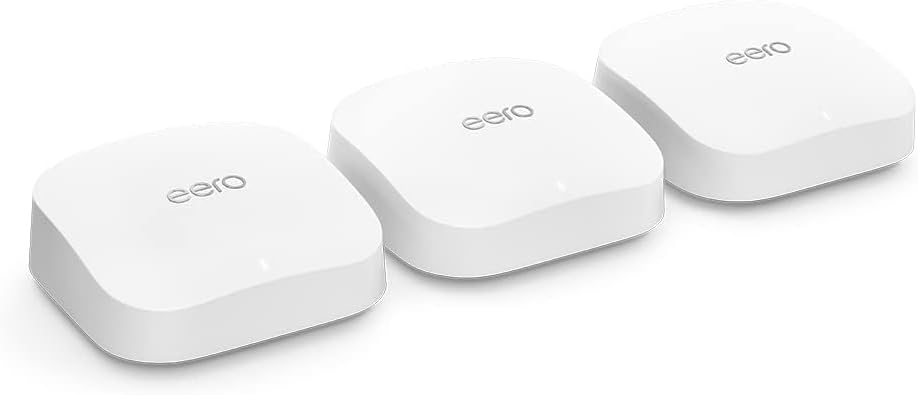
A mesh system is the answer to a house where the router cannot reach the far bedroom, and the thing that separates a good one from an expensive one is rarely the headline speed. A tested field of mesh kits makes the real differences clear: how the stations talk to each other, what happens beyond the gigabit barrier, and what the manufacturer requires of you before the thing will work at all.
What a mesh actually does
Every station broadcasts the same network name with the same password, so all your devices stay connected under one set of credentials. Which station you are attached to at any moment, and when a phone is handed over to a nearer or less congested one, is something you normally never notice. That is the entire point.
The one thing you must get right is placement. The stations cannot be too far apart, and the tools for judging this are unglamorous but effective: connection LEDs on the housing, or a positioning aid in the manufacturer's app.
In every mesh, one station acts as the router and makes the internet connection — variously called the mesh router, mesh base or mesh gateway. The rest extend from it.
Wi-Fi 6 or Wi-Fi 7, and why tri-band is not a given
The tested field spans both standards, and newer does not automatically win.
Wi-Fi 7 kits in the group are dual-band designs with 160 MHz channel width, which is what lets them push data rates past the 1-gigabit mark. The premium option adds genuine tri-band Wi-Fi 7 with 4×4 MIMO streams, and the measured result was extremely fast: beyond 2 and even 3 Gbit/s net.
The subtlety is that "tri-band" is used loosely. One Wi-Fi 6 kit in the field runs three separate radio modules with a fast 4×4 backhaul — the dedicated channel the stations use to talk to each other — and performs strongly because of it, yet the testers were explicit that it is not true tri-band, because there is no 6 GHz band. Three radios and three bands are different claims.
Ports matter more than people expect
If your broadband is faster than a gigabit, the wireless speed is not your bottleneck — the wired ports are. Most of the recommended kits carry 2× 2.5 GbE ports per station, which is what allows fast wireless throughput to reach the rest of the home network unthrottled. The high-end option goes further with 2× 2.5 GbE plus 2× 10 GbE per station.
At the other end, one budget-friendly kit provides three gigabit ports per station, which is perfectly adequate on a sub-gigabit line and a real constraint above it.
What the field gets wrong
Three findings from the wider tested field are worth carrying into any purchase, whichever kit you buy.
"Wi-Fi 6" is not always Wi-Fi 6. One kit in the group was called out as a mislabelled package: Wi-Fi 6 on paper, but only Wi-Fi 4 on the 2.4 GHz band. The badge on the box describes the best case, not every band.
Upstream is not downstream. One system's wireless upstream reached only about 50% of its downstream rate — fine for streaming, much less fine for video calls, cloud backup or uploading large files.
5 GHz channel restrictions are common. Several kits use only channels 36 to 48, or 36 to 64, for 5 GHz clients. That limits how well they can dodge congestion in a crowded building. Related: on channels where radar detection is active, mesh rates drop measurably — though the systems recover to their original configuration within about 10 minutes.
On running costs, the measured draw is modest across the field: a mesh router with both LAN ports occupied takes a little over 8 W, and a repeater with its ports unused about 7 W.
The strings attached
This is the section most guides skip, and it separates these kits more than performance does.
One winner's extended security suite costs extra beyond the free tier — though the free parental controls were judged genuinely usable rather than a teaser. Another kit's mesh function requires a cloud account to work at all, which is a meaningful condition rather than a detail. A third has an awkward quirk worth knowing before you buy: activating its VPN client disables the parental controls.
There is also a security finding worth stating plainly: on the high-end kit, the USB network-storage feature ships with an SMBv vulnerability. The mesh itself is excellent; the NAS function is not something to expose casually.
The picks
Best overall — TP-Link Deco BE25 (2-pack). The test winner. Dual-band Wi-Fi 7 with 160 MHz delivering rates well beyond a gigabit, and two 2.5 GbE ports to carry them into the home network. Setup is straightforward and the reworked Deco app handles full control and remote access — the difficult balance between capability and usability, managed. It includes a guest network, simple prioritisation, a VPN client, connection preferences and the ability to isolate specific clients on the main network. Setup is quick — allow roughly 3 minutes on top for the download, update and restart. Power consumption is modest. Against it: extended HomeShield protection costs extra, the English PDF manual covers setup only, and the web interface is limited.
Most features — Asus ZenWiFi BD4 (2-pack). Also dual-band Wi-Fi 7 with two 2.5 GbE ports and 2×2 radios, controllable by app or browser. Its strength is breadth: VPN Fusion for client connections to VPN providers, plus extensive network-protection and child-safety features with no subscription costs, and a 3-year warranty. The drawbacks are a fiddly setup — both stations had to be connected by cable first — a German PDF manual with broken links and a somewhat cluttered app. It also needs one specific adjustment out of the box: to reach its high data rates you must open the advanced Wi-Fi settings and change the 5 GHz channel bandwidth from 80 MHz to 160 MHz. Left alone, it underperforms for no obvious reason.
Best documentation and support — AVM FritzMesh Set 4200 (2-pack). Only Wi-Fi 6, but three separate radio modules with a strong 4×4 backhaul make for fast mesh links, and ZeroWait DFS management keeps the 5 GHz band stable. Documentation was called exemplary, parental controls are comfortable to use, there is both a VPN client and server, and the warranty runs 5 years. Against it: expensive, no relay-based remote access, not true tri-band, and the VPN-client-versus-parental-controls conflict noted above.
Fastest — TP-Link Deco BE85 (2-pack). Tri-band Wi-Fi 7 at 4×4 MIMO with four multi-gigabit LAN ports per station, and it delivers: measured throughput beyond 2 and even 3 Gbit/s net. Comprehensive settings, parental controls with content filtering, reliable remote access and the same well-judged Deco app. The costs are real — significantly more expensive than the rest and a much higher power draw — plus the USB NAS security issue.
Best value — TP-Link Deco X50 (2-pack). Comparatively inexpensive, with strong Wi-Fi 6 dual-band that connects capable clients at 160 MHz, simple setup, a functional app with remote access, web filtering and smart-home support, and three gigabit ports per station. Limitations: only channels 36 to 64 are used on 5 GHz, the mesh requires a cloud account, and the manual is English-only.
A naming caution: the Deco X50 mesh kit is a different product from the Deco X50-5G, which is a mobile router rather than a mesh system. The model numbers are nearly identical and the products are not.
Before you order
Check the pack size. Every recommendation above was tested as a 2-pack, and UK listings routinely offer 1-pack add-ons and 3-packs of the same model. Those are different products with different coverage and different prices, not variants of the same purchase — buy the configuration that matches your home rather than whichever appears first.
Search current listings: mesh Wi-Fi systems on Amazon UK | Amazon.com. Test winner: Deco BE25 on Amazon UK | Amazon.com. Value pick: Deco X50 on Amazon UK | Amazon.com.