A holiday flat with hostile Wi-Fi, a hotel room on a business trip, a caravan pitch in the middle of nowhere — wherever a mobile signal reaches, a battery-powered mobile router builds a private, secure wireless network of your own, and the whole family's phones, tablets and notebooks connect as if at home. This guide draws on a laboratory test field of 18 benchmarked mobile 5G/LTE routers to name the winner, a superb 108-euro price tip and three specialised alternatives, then explains what actually matters when buying: which mobile networks a router can reach, how long its battery genuinely lasts, and which features earn their surcharge.
Within the European Union, uniform roaming rules make your home SIM the easy option; further afield, a cheap local prepaid SIM in the router is usually the smarter play. The router does the rest.
The Short Version
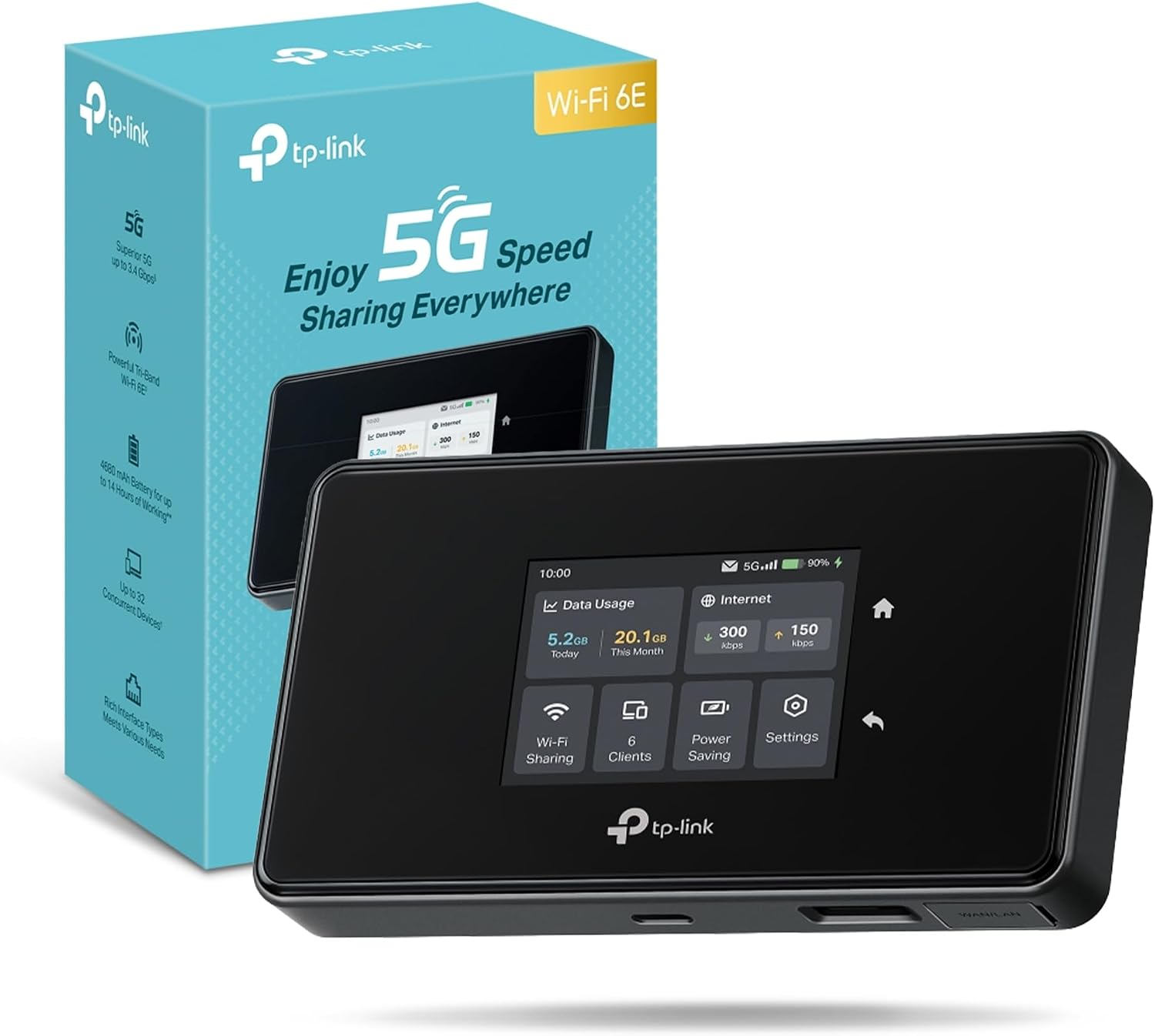
- Test winner — TP-Link M8550. 5G on all important bands, fast Wi-Fi 6E with 583 Mbit/s measured, a touchscreen, VPN capability and a swappable battery — "very good" (1.4) at around 344 euros.
- Price tip — TP-Link M7650. No 5G, but nearly 17 hours of measured runtime, solid Wi-Fi speeds and a swappable battery for around 108 euros, with the field's best value rating.
- Budget pick — Huawei E5586-326. A bare-bones LTE hotspot for around 40 euros that still manages WPA3 encryption and a repeater mode.
- Top alternative — Netgear Nighthawk M7 Pro. The field's best equipment and Wi-Fi performance grades: Wi-Fi 7, 617 Mbit/s measured, 64 devices — at a stiff 849 euros.
- Best battery — Acer Enduro Connect M3 5G. Almost 22 hours of continuous 5G duty at around 221 euros, if you can live without a swappable cell.
The Winner: TP-Link M8550
The M8550 wins by being complete. It connects on all important frequency bands in both the 5G and LTE networks, spans a wide 160-megahertz channel on the Wi-Fi 6E standard, and the measurements back the specification: 583 Mbit/s in the wireless download test and 509 in upload — excellent for a battery-powered device. Up to 32 devices connect simultaneously under modern WPA3 encryption, and the physical connections go beyond the class norm: a 1-gigabit LAN/WAN port, sockets for two external antennas to improve reception, and a micro-SD card slot.
Functionality earned a perfect 1.0. The router works as a VPN server or client — reaching your home network securely from abroad, or pulling every connected device into a protected company network — and doubles as an access point when a wired connection is available; only a Wi-Fi repeater mode is missing. Control runs three ways: a 2.4-inch touchscreen with an unusually deep settings menu, a phone app, and a web interface, with WPS pairing and even SMS send/receive on top. The compromises are modest: 8:58 hours of measured runtime is merely decent (the battery swaps in seconds, and charging takes about three hours), and 274 grams is on the heavy side of pocketable. Verdict: "very good" (1.4), rated "cheap" at around 344 euros.
The Price Tip: TP-Link M7650
Related Articles
The M7650 is the endurance bargain. It ran 16:58 hours in the continuous-use measurement — nearly twice the winner's figure — charges in about three and a half hours, swaps its battery, and weighs just 138 grams in a genuinely compact housing. That combination earned a perfect mobility grade, and the wireless numbers hold up despite the older Wi-Fi 5 standard: 294 Mbit/s down, 317 up, for as many as 32 connected devices.
The savings are all visible on the spec sheet. There is no 5G — and not even every LTE band is supported — no LAN port, no external antenna sockets, and the 1.44-inch display only shows information rather than accepting touch input, so settings run through the phone or web app. The genuine weakness is security: WPA3 encryption is not supported, which rules it out for the cautious. For everyone else, a micro-SD slot and USB tethering sweeten what is, at around 108 euros with the field's best value rating (1.0), the sensible default for holiday use. Verdict: "good" (2.3).
The Budget Pick: Huawei E5586-326
At around 40 euros, the E5586-326 strips the concept to its chassis. LTE connectivity covers all the important bands, but the wireless network runs on the ancient Wi-Fi 4 standard in the crowded 2.4-gigahertz range with a narrow 40-megahertz channel — the measured 92 Mbit/s down and 101 up are modest, though still perfectly usable for mail, browsing and standard-definition streaming for up to 16 devices. There is no display at all; everything runs through the phone or web app.
Two surprises rescue it from pure minimalism: WPA3 encryption is supported — which the ten-times-dearer M7650 cannot say — and it even works as a Wi-Fi repeater, plus USB tethering. At 83 grams it vanishes into any pocket, the swappable battery runs about 7.5 hours, and USB-C charging finishes in under two hours. Verdict: "satisfactory" (2.9) — but "very cheap" (1.1), and exactly right as a glovebox backup.
The Top Alternative: Netgear Nighthawk M7 Pro
Related Articles
The Nighthawk M7 Pro is what the class looks like without a budget. It earned perfect 1.0 grades for both equipment and Wi-Fi performance: all important 5G and LTE bands, the current Wi-Fi 7 standard with a 320-megahertz channel, and measured rates of 617 Mbit/s down and up to 600 up — outstanding for a mobile router — for as many as 64 simultaneous devices. A 2.5-gigabit LAN/WAN port, two external antenna sockets and a large 2.8-inch touchscreen complete the hardware.
The gaps are curious rather than crippling: no WPS, no VPN server or client, and — oddly for a premium device — no phone app, leaving the touchscreen and web interface for control, though USB tethering, access-point and repeater modes are all aboard. The swappable battery ran a strong 13:10 hours, with a slow near-four-hour charge. The real obstacle is the price: around 849 euros, rated "expensive" (4.2). Verdict: "good" (1.7) — the pick when a whole team hangs off one router.
Best Battery: Acer Enduro Connect M3 5G
The Enduro Connect M3 5G answers one question emphatically: 21:52 hours of measured continuous operation, the longest in the field, with full 5G and LTE band support. Wi-Fi 6 delivers unspectacular but flawless speeds — 206 Mbit/s down, 236 up — under WPA3 encryption, and a 2.4-inch touchscreen handles control alongside the web interface, with a VPN server mode as a welcome extra.
The economies sit in the details: only 16 simultaneous devices, no LAN port or antenna sockets, no WPS or access-point mode, no phone app — and, the one real shame, the big battery cannot be swapped, only recharged over about three and a half hours. At 250 grams it stays compact and travels well. Verdict: "good" (2.4) at around 221 euros — the touring companion for long days off-grid.
How Much Does a Good Mobile Router Cost?
Price follows standards. Solid LTE-only routers with older Wi-Fi start around 150 euros — our price tip undercuts even that — while 5G support with Wi-Fi 6 begins near 250 euros, and adding Wi-Fi 6E or 7 with premium equipment can push beyond 900. The honest question is what the router will feed: a couple on holiday streaming in HD needs far less than a mobile office. As the measurements above show, the correlation between price and the speeds you actually experience is loose — the 108-euro M7650 out-runs the 849-euro Netgear on battery by hours.
How a Mobile Router Works
A stationary router plugs into a fixed line; a mobile router carries a SIM card and drinks from the mobile networks instead. On site it spins up its own wireless network, so a single data contract feeds as many phones, tablets and notebooks as the device supports — plus, on better models, wired devices through a LAN port or USB tethering. That is the whole trick, and it is most valuable exactly where hotel and holiday-flat Wi-Fi is at its worst — shared, slow, and about as private as a postcard. Your own router means your own encryption, your own password and no strangers on the network.
What to Look For When Buying
Mobility and the battery question
Compact and light wins the suitcase, but miniaturisation has costs: the smallest models drop the display, the LAN port and battery capacity. Manufacturers rarely publish honest runtimes, which is why the measured figures above — from under 8 to almost 22 hours — matter more than the datasheet. A swappable battery is a quietly major feature: a spare cell in the luggage doubles your off-grid time, and a worn battery stops being a reason to bin the router. All models charge while operating, and some run mains-only with the battery removed, sparing it in stationary use.
Network and Wi-Fi standards
LTE data rates suffice for browsing and moderate streaming; 5G raises the ceiling sharply but is dearer on both the router and the tariff, and coverage remains patchy. Check band support either way — not every router uses every important frequency band, and missing bands cost real-world speed. On the Wi-Fi side, the standard sets the theoretical ceiling: Wi-Fi 4 crawls in the crowded 2.4-gigahertz range, Wi-Fi 5 and 6 add the 5-gigahertz band, and Wi-Fi 6E and 7 open the 6-gigahertz range — provided your devices speak the same standard. Newer is faster and dearer, and top speeds are ideal-conditions numbers.
Control, security and the useful extras
Cheaper routers manage everything through a phone app or browser interface; dearer ones add displays and touchscreens for on-device control, including data-volume monitoring and caps — invaluable near a roaming limit. On security, insist on WPA3 where you can: the predecessors are no longer considered secure, though some small routers lack the processing power for it. VPN modes turn a good router into a travel office, access-point and repeater modes let it piggyback on hotel connections without re-pairing every device, USB tethering feeds Wi-Fi-less hardware, and external antenna sockets rescue reception at the edge of coverage. A micro-SD slot on some models even serves shared storage to the whole network.
How the Routers Were Tested
Equipment counts 30 per cent of the verdict: maximum LTE and 5G data rates, the Wi-Fi standard and frequency bands, display, battery details and physical connections. Functionality (25 per cent) grades the settings depth for mobile, Wi-Fi and battery, encryption and security features, apps, ergonomics and extras. Mobility (25 per cent) combines size and weight with a standardised battery trial — a connected phone simulating constant internet use while a notebook loops a 1080p video, all power-saving features active — plus the measured charging time. Wi-Fi performance (20 per cent) measures maximum throughput across eight simultaneous data streams between two connected notebooks, with the router always running on battery.
Frequently Asked Questions
Can I stream or game through a mobile router?
Both work. For video, stay at HD or Full HD: 4K burns through both speed and data volume, and foreign tariffs often throttle after a modest daily allowance. Download films — and any games and updates — before travelling.
Can I run a mobile router from a power bank?
Generally yes — connect the two with the charging cable and the router keeps serving. Paired with the long-runtime picks above, that covers even multi-day trips; our laptop guide covers the machines most likely to hang off it.
Why not just use my phone's hotspot?
For checking mail, do. For real work, the router wins: it feeds many devices without draining your phone's battery or its contract, and it accepts a cheap local SIM — usually cheaper than booking extra gigabytes onto a domestic contract, and essential where EU roaming rules don't apply.
What is the difference between 2.4 and 5 gigahertz Wi-Fi?
The 2.4-gigahertz range is universal but crowded — keyboards, headsets and mice all share it, and congestion makes connections slow or unstable. The 5-gigahertz range is emptier and faster at slightly shorter range; Wi-Fi 6E adds the 6-gigahertz band on top. Devices like the tablets in our current guide support the modern bands as standard.
The Bottom Line
Eighteen tested mobile routers split cleanly along the question of what you carry them for. The TP-Link M8550 is the complete package — 5G, fast Wi-Fi 6E, VPN, touchscreen — at a fair 344 euros, and most buyers should stop there. The M7650 serves the classic holiday case for 108 euros with double the runtime, the 40-euro Huawei covers emergencies, the Netgear M7 Pro buys the fastest wireless in the field for team-sized workloads, and the Acer M3 5G simply outlasts everything. Match the standards to your devices, insist on WPA3 unless the price argues otherwise, and pack a spare battery where the router allows one — it is the cheapest upgrade in mobile networking.