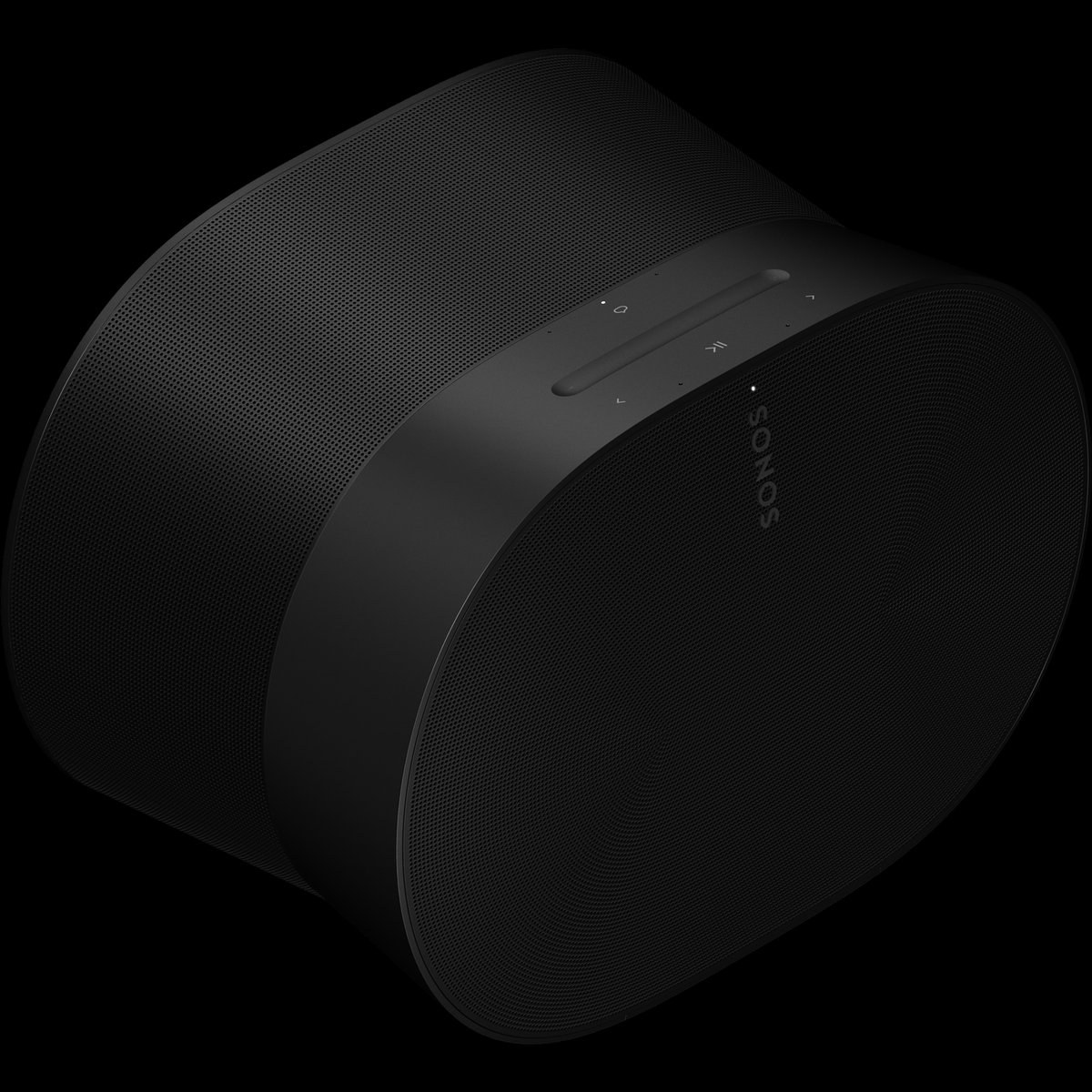
Sonos: The Benchmark Platform
Unlike its rivals, Sonos built its system on proprietary wireless technology from the start. Where ordinary Wi-Fi radiates outwards from a central router, each Sonos component acts as its own repeater, passing the signal on to the next device. That is a major advantage in homes where the router's Wi-Fi does not reach every room: under comparison conditions, the Sonos system played music happily in rooms where normal Wi-Fi playback had already given up. For this mesh mode one speaker must be cabled to the router — or you use the Sonos Bridge.
The historic downside of the proprietary approach was the obligatory Sonos app: you could not, for instance, simply play music from Apple's Music app to a Sonos speaker. That changed with AirPlay 2 support, which Sonos now embraces.
Trueplay: room correction without the price tag
Sonos speakers also compete at the front of the field sonically, and one clever function deserves much of the credit. Trueplay measures the room using an iPhone or iPad: the speakers play test tones while you walk the room with the phone, and the gathered data tailors each speaker to the room's acoustics. The change is subtle but audible. High-end hi-fi has used room calibration for years, but always with a bundled, standardised microphone that made it expensive; Sonos achieves it at no extra cost by exploiting the ubiquity of Apple devices — one of the great innovations of recent years. Android phones are excluded from phone-based measurement because there are simply too many models with too many different microphones, but the newer mobile speakers solve the problem differently: the Roam 2 and Move 2 measure the room automatically through their own built-in microphones after every repositioning, finally giving Android users feature parity.
Almost all Sonos speakers can be combined into stereo pairs — the soundbar and soundbase are the exceptions — and the platform now hosts multiple voice assistants side by side. Amazon Alexa and Google Assistant can each be assigned per speaker, and Sonos Voice Control processes commands entirely on the device rather than in the cloud, an important point for the privacy-conscious. Its limitation: it currently understands only English and French, and it controls playback rather than answering questions about the weather.
The app crisis
Sonos has long led on usability, but the biggest app overhaul in its history, released in April 2024 with a customisable home screen, new navigation and a companion web app, triggered waves of complaints about dropped connections and unstable operation. At the height of the uproar Sonos even considered reverting to the old app, which proved technically impractical. The pragmatic workaround for connection problems is switching from Wi-Fi to wired Ethernet for the affected components. If the company does not stabilise things soon, it risks the market-leading position it has held for years — worth knowing before you buy, even though the hardware remains excellent.
Sound Quality: Where Each Brand Stands
Speaker for speaker, Bose and Harman edge slightly ahead of Sonos in isolated comparisons — with one big exception: playing alone, the Sonos Five was the best-sounding speaker of everything auditioned.
Sonos Five
Check Sonos Five speaker price on Amazon UK · Search Amazon US
The Sonos Five shows its lineage from the Play:5 inside and out. Its closed cabinet of robust plastic houses six drivers: three dome tweeters in the top row, two firing sideways through waveguides for a wide stereo base and one aimed straight ahead for stable imaging and clearer voices, plus three actively driven mid-woofers below. Closed-box designs promise more bass precision than bass-reflex cabinets, and the Five delivers: a genuinely juicy punch.
In the listening comparison the Five set off with verve even as a soloist, convincing before any Trueplay measurement with an extremely full yet differentiated sound. Punch and detail resolution lift it far above the smaller boxes in the range, and the bass extension is remarkable — no passive speaker of this compact format gets close. The sound simply energises, especially with rock, pop or hip-hop, and even jazz and classical please anyone not determined to pick out the third violinist from the left. Compared with the Sonos One it builds a wider soundstage and sounds many times more grown-up, powerful and authentic, though true stereo imaging from a single box requires considerable goodwill. Trueplay adds a touch more precision and balance, but cannot fully counteract the lush upper bass that occasionally crowds the vocal range — Sonos voices its speakers warm and slightly dark, and the mixture has an infectious rhythm and drive that never becomes pushy. The factory-enabled adaptive loudness works subtly and fades with rising volume; switch it off at normal listening levels and you will barely hear a difference.
The 5-series remains the best speaker Sonos makes, with better balance than its predecessor — though the swipe gesture on the top touch panel for track skipping takes practice before you stop pausing playback by accident.
Sonos Roam 2
Check Sonos Roam 2 price on Amazon UK · Search Amazon US
The mobile Roam 2 gained colour-matched logos and, far more importantly, separate buttons for power and Bluetooth pairing — and it no longer demands Wi-Fi setup first. Take it out of the box and connect immediately via Bluetooth like any ordinary portable speaker. Battery life stays at up to ten hours of playback (up to ten days on standby), automatic Trueplay continuously adapts the sound to the surroundings over Bluetooth or Wi-Fi alike, and the IP67 rating keeps dust and water out for outdoor use. Five colours are available, and the Roam 2 can even be stereo-paired in the app with a first-generation Roam.
The tuning is unchanged — sensible, given that cross-generation pairing — and there was little to criticise anyway: tonally as balanced as the bigger Sonos speakers, with astonishingly full bass for the format, though maximum volume has physical limits. The unobtrusive side buttons are best treated as a fallback; voice commands via Google Assistant or Alexa are more convenient, and a button on the panel cuts the microphone for privacy. For extending a Sonos network towards the balcony and garden, the 430-gram Roam 2 is exactly right — you just pay more than for a sonically comparable pure Bluetooth speaker, in exchange for the multiroom integration.
Subwoofers, Soundbars and Home Cinema
The home-cinema side of the ecosystem — the Beam, Arc and Ray soundbars — can be expanded with two Era 100s as surround channels and a Sub or Sub Mini for the low end, making the sound markedly more dynamic, spacious and broadband. We cover that category in depth in our guide to the best soundbars.
Sonos Move
The original Move was the first Sonos speaker with Bluetooth, built for mobility with an internal battery and a charging ring dock good for up to ten hours of playback. Protected against dust and water jets, it goes to the bathroom or garden without worry, its lower section wrapped in a rubbery surface against moisture, dirt and knocks. A true portable it is not: three kilograms and 16 × 24 × 12.5 centimetres make it a speaker for warm evenings on the terrace rather than trips to the lido.
It sounds enormously full and reaches high volumes effortlessly even in a larger living room. The closed two-way construction with its distinctive waveguide before the dome tweeter delivers natural, undistorted voices, eager dynamics and convincingly clear treble. In sheer boogie factor the Move is about the best speaker in the range: the bass, plumped by the ever-active dynamic loudness and anything but dry near a wall, times its powerful impulses so well that rock, pop and electronic beats acquire real charm. The stripped-down Bluetooth mode bypasses the Sonos app entirely — Sonos points users to AirPlay 2 and app-linked streaming services instead — and a far-field microphone array serves Alexa and Google Assistant. The top touch panel takes acclimatisation and the rear-mounted Bluetooth/Wi-Fi switch is not ideal, but the Move remains the do-everything speaker of the American line-up at a fair price.
Sonos Move 2
Check Sonos Move 2 price on Amazon UK · Search Amazon US
The Move 2 adds two tweeters angled outwards at the edges of the curved baffle, producing virtual stereo from a single box — a better sense of space that makes it sound acoustically bigger than it is, even if real stereo still demands a second, distant speaker. The other headline gain is endurance: up to 24 hours, more than double the predecessor, at an unchanged weight of around three kilograms. The USB-C port doubles as an analogue line input with an optional adapter, welcoming turntables and CD players, and automatic Trueplay keeps the tuning matched to wherever it stands. Controls follow the Era series, with swipe-based volume, and the microphone — used for both Trueplay and voice control — can be hardware-muted. Sonos's own voice control works in Bluetooth mode as well as on Wi-Fi.
Sonically the Move 2 delivers full, clean bass, clearly defined treble and balanced mids, making it one of the best speakers in its weight class. The bass does not quite match the precision of a dedicated hi-fi loudspeaker, but the overall tuning, the fat foundation and the ability to fill a whole room put it among the strongest portable speakers — and for Sonos householders it slots seamlessly into the system on its charging ring.
Sonos One
The One succeeded the discontinued Play:1 and moved a woman in — Alexa. It sounds worlds better than Amazon's own Echo speakers while embedding the assistant in the proven Sonos ecosystem. under comparison conditions, controlling Sonos speakers from an Echo proved unreliable, but voice control through the One itself worked without issue, even from a distance, making the app optional for daily use. The sound is essentially the Play:1's, with at most a little extra polish and transparency — no bad thing. The microphone switches off entirely for privacy, which matters, because setting up Alexa involves a veritable password-entry marathon and, depending on your disposition, some data-protection stomach ache.
Sonos Era 100
Check Sonos Era 100 price on Amazon UK · Search Amazon US
Positioned above the One, the Era 100 pursues virtual stereo where the entry-level model stays mono, and two units pair into true stereo. As a smart speaker with its own microphone array it accepts Amazon Alexa or the on-device Sonos Voice Control, whose command recognition stays remarkably reliable even during playback; a rear switch hardware-disables the microphones. Bluetooth is built in — new for Sonos home speakers — and a USB-C adapter (not included) accepts analogue sources via mini-jack; Ethernet now also requires an adapter, as the Era 100 ships Wi-Fi-only.
Sonically the Era 100 is a big step beyond the One: a much larger stage, wider bandwidth, fuller and more contoured bass, more transparent mids and livelier, better-resolved treble, with the gap growing as volume rises. A major success in the entry segment.
Sonos Era 300
Check Sonos Era 300 price on Amazon UK · Search Amazon US
The larger Era 300 plays Bluetooth and (via the separate adapter) analogue sources, and its elaborate driver array — set in a cabinet with a wraparound rear baffle — reproduces Dolby Atmos, for instance from Amazon Music Unlimited HD or Apple Music streams, and can upmix ordinary audio with a 3D effect. It sounds far bigger than it is, upwards and sideways, and against the dearer Five it delivers a terrific show for the money.
The tuning is balanced with a mighty bass that Trueplay adapts to the room using the speaker's own microphones — which finally brings Android users into Trueplay, while iPhone owners can still choose the more precise phone-based measurement. Voice assistants respond even over loud music, a slider hardware-mutes the microphones, and the recessed swipe groove for volume is a genuine ergonomic improvement. The verdict: convincingly three-dimensional Atmos, remarkable level reserves, and bass substance that only villa owners will want to supplement with a subwoofer. It squeezes the costlier Five hard — with one placement caveat: because of its upward- and side-firing 3D drivers the Era 300 cannot simply be slid into a free shelf slot; it must sit on top of a unit or on the separately sold stands or wall mounts.
Living With Sonos: AirPlay 2, Siri, Alexa and the Android Question
For years the Sonos app was the gateway to everything; Spotify could address the speakers directly, but music from YouTube or other apps was out of reach. AirPlay 2 changed that, at least for Apple devices: songs play from any app — even a browser tab — straight to all speakers. under comparison conditions it worked well, with caveats: track skips respond a touch slower, occasionally one speaker starts a second before the others, and once a speaker dropped out and resumed out of sync; a quick stop/start fixed it. Older Sonos speakers join AirPlay 2 only when grouped in the Sonos app with a newer model (Beam, One, Playbase or Five), and they do not appear individually in the iOS speaker picker.
AirPlay also unlocks Siri: after assigning speakers to rooms in Apple's Home app, "turn the music up in the living room" adjusts all the right speakers, and "play Daft Punk everywhere" fills the house. That room-group handling actually beats the longer-established Alexa integration, which still struggles to address speaker groups. Siri's weaknesses are the mirror image: playlists start only from Apple's own Music app, not Spotify (although volume, skip and pause work once Spotify is playing), and Siri needs an iPhone or iPad within earshot, whereas Alexa's far-field microphones hear you across the room. Each has its advantages.
Android users remain the poor relations: Sonos supports AirPlay 2 but not Google's Chromecast, so flexibility on Android still lags the iPhone, though Spotify and similar apps drive the speakers directly. Many owners will happily stick with the Sonos app regardless — it is beautifully designed, responds instantly, and supports by far the largest portfolio of streaming services of any manufacturer: Spotify, Apple Music, Deezer, TuneIn, Amazon Music, SoundCloud and many more.
Bose Smart Home
Bose's old SoundTouch multiroom series is fading from the market, replaced by the growing Smart Home family, best known for the Home Speaker 500 and the Portable Smart Speaker. The painful catch for loyal Bose customers: the two series are not compatible with each other. Taken on its own terms, though, the new range delivers the accustomed Bose quality — full, balanced sound across the board.
Bose Portable Smart Speaker
Check Bose Portable Smart Speaker price on Amazon UK · Search Amazon US
The Portable Smart Speaker's signature is its omnidirectional 360-degree design: a wideband driver fires downwards onto a cone-shaped acoustic dispenser that spreads sound evenly in all directions, while two oval passive radiators firing left and right underpin the bass — a combination that works well, since bass is non-directional anyway. The bucket-style carry handle tops a robust, water-resistant (IPX4) housing in black or white.
Setup dragged — not helped by a firmware update that alone took a quarter of an hour — but the equipment list consoles: Bluetooth and Wi-Fi, AirPlay 2, indoor and outdoor use, up to 12 hours of battery, a USB-C charger in the box and an optional drop-on charging cradle. Control comes three ways: voice (Google Assistant or Alexa via a microphone array that hears reliably from a distance), the top-mounted touch buttons with their low-contrast markings, or the Bose Music app for Android and iOS. Six preset buttons store favourite playlists or internet-radio stations for one-touch recall — Bose traditionally values operation without a smartphone in hand, and it shows. A light bar provides the visual feedback that the Home Speaker 500's small colour display handles on its big brother.
Teufel
The Berlin speaker house has reworked its multiroom range once more. The new generation — the Motiv Home all-in-one, the compact Stereo M 2 pair and the Stereo L 2 floor-standers — runs on the Teufel Home app and supports AirPlay 2 and, once again, Google Cast, with network streaming up to 32-bit/384 kHz. The older One S and One M continue in parallel on the Teufel Raumfeld app, streaming high-resolution audio at up to 24-bit/192 kHz — but the two app generations are not compatible, so Teufel's broad portfolio cannot be combined freely. Buyers must pick a generation.
Sonically the new Teufel speakers are a genuine treat: clearer in the treble, more transparent and differentiated in the mids and deeper, drier in the bass than comparable Sonos boxes. From the One M upwards this is proper hi-fi, just with a narrower stereo base; the two-channel Stereo M 2 and L 2 sets leave practically nothing to be desired against a conventional hi-fi system, in purity and in spacious, three-dimensional imaging alike.
Teufel Motiv Home
Check Teufel Motiv Home price on Amazon UK · Search Amazon US
The Motiv Home opened the new onebox generation in 2023. Side-firing drivers and the "Dynamore Ultra" sound-expansion technology borrowed from Teufel's soundbars aim to fill the room from one compact cabinet. It is larger and heavier than typical battery portables — conceived as a main living-room system that occasionally joins a garden or balcony party, helped by the integrated handle but limited outdoors by the lack of water and dust resistance.
Its source list is generous: Bluetooth, AirPlay 2, Spotify Connect, Tidal Connect and Google Cast, plus an analogue input for traditional kit. Seventy watts drive the 2.1 speaker around its central subwoofer chassis, passive radiators reinforce the powerful bass, and the Home app adds a three-band equaliser beyond the comprehensive onboard controls. The Motiv Home impresses with natural tuning, muscular bass and room-filling audio, especially over Wi-Fi; the missing aptX support for Android and the indoor-only build are its limits. Within its niche, remarkable sound quality and versatility.
Teufel Stereo M 2
Check Teufel Stereo M 2 price on Amazon UK · Search Amazon US
For more level, bandwidth, resolution and a genuinely wide stereo image, the Stereo M 2 pair steps up. The second generation abandons the master-and-slave principle: no more long XLR cable to the second box — each speaker now carries its own amplification, separately for each of its three driver sections, enabling tighter chassis control and a fully wireless link between the pair (a Toslink optical cable, sold separately, remains an option for tricky cases). Each box pairs Teufel's coaxial mid-tweeter with a Kevlar woofer, driven by three amplifier channels totalling 100 watts RMS per speaker. Round the back sit an analogue cinch input and a Toslink input per primary box, with the second optical port acting as the output for a cabled pair.
The sound is astonishingly full in the bass for the size, if slightly soft — not mushy, but not kick-bass-forward either — with voices on the lean side yet never hard. The bass foundation is genuinely imposing for so compact a multiroom speaker. Against the One M, the Stereo M 2 asks for more space and budget; against a real hi-fi system, the price is excellent, because the amplifiers and CD player it replaces are already inside.
Teufel Stereo L 2
Those with higher demands on precision and volume — and the space — get 1.17-metre floor-standing columns. The Stereo L 2 follows the M 2's architecture: own amplification per speaker at 190 watts RMS per channel, wireless or optical pairing, the same coaxial mid-tweeters and Kevlar woofers, but three of each stacked per column, all managed by the Home app with its three-band equaliser.
Anyone expecting simply more and fatter bass will be surprised: the L 2 sounds more precise in the lower octaves, less inflated on bass-heavy recordings — more grown-up, and more relaxed at high levels. Purist hi-fi listeners are better served here long-term, at double the outlay, essentially buying a tauter bass and bigger level reserves; vocal reproduction gains nothing over the compact pair, which images even slightly more accurately. The L 2 competes with a good hi-fi system in sound — and in price — its remaining advantage being the elimination of electronics boxes and cabling.
Teufel One S
The little One S leans on side-mounted passive radiators to plumb lower octaves astonishingly well for an 18-centimetre cabinet. It is deliberately a wideband mono design around a coaxial mid-tweeter — concentric drivers approximating the ideal point source — which works better from a distance than close up, where the midrange turns slightly artificial. Level reserves go well beyond desktop duty: from two metres in small to mid-sized rooms the One S plays fresh and full. Its character emphasises the frequency extremes, leaving voices a little thin and tinny next to the warmer, more rounded Sonos One; it suits listeners who want predominantly electronic music to properly kick.
Teufel One M
The mid-sized One M is the sonic gem of the range. The 42-centimetre-wide single unit can genuinely replace a small stereo system: it adds at least three shovelfuls over the One S in bass and treble, concedes nothing in the mids, and sounds classes more natural and neutral than its little sister — even out-resolving the Sonos Play:5 in midrange differentiation and transparency. Where the American rival favours soft bass, the One M counters with precision and depth, and its armada of seven active plus two passive drivers throws a substantial cloud of sound. Natural voices with startling detail keep long, loud sessions fatigue-free. Three freely assignable favourite buttons grace the front — though the labels stamped into the metal keys become nearly invisible at dusk.
The software side trails the hardware. Ethernet setup — normally the convenient route — defeated an entire afternoon and a firmware update; Wi-Fi setup succeeded after flashing new firmware from a USB stick to the first speaker, after which the remaining speakers joined the network easily and pulled updates from the internet like Sonos or Bose. The network collapsed again, however, when the first speaker was removed — the developers still have work to do. The app itself is handsome and intuitively structured, responds far faster than it used to, but occasionally jumps the volume when you switch back to it from the background.
Teufel's privacy stance deserves praise — no manufacturer registration is required at all — and a single app covers Tidal, Napster, Spotify, integrated TuneIn web radio and local playback. But many popular services, including Apple Music, Amazon Music, Deezer and SoundCloud, reach Teufel boxes only via Bluetooth, which disables multiroom. There Sonos keeps its lead.
Yamaha MusicCast
Yamaha entered the wireless multiroom world at scale with a different philosophy: rather than inventing new speaker concepts, it equips its entire hi-fi and AV component range — anchored by its popular AV receivers — with Wi-Fi under the revived MusicCast banner. That is a real advantage if a good conventional stereo system already lives in your home: instead of scrapping it, a MusicCast amplifier or receiver makes the existing kit multiroom-capable. And the Japanese attack the Americans at their vulnerable spot: where Sonos streams at roughly CD level, MusicCast handles hi-res audio at 24-bit/192 kHz.
Yamaha MC 20
Check Yamaha MusicCast 20 MC-20 price on Amazon UK · Search Amazon US
The compact MC 20 (150 × 186 × 130 millimetres, 2.2 kilograms) packs a 9-centimetre woofer on a 40-watt Class-D stage, a 1.3-centimetre soft-dome tweeter with 15 watts of its own, and two passive bass radiators. It suits stereo pairing or rear-speaker duty in a surround setup, hangs on a wall via keyhole mount or standard tripod thread, and streams MP3/WMA/AAC up to 16-bit/48 kHz, ALAC to 24-bit/96 kHz and FLAC/WAV/AIFF to 24-bit/192 kHz over a sufficiently strong Wi-Fi signal. Bluetooth handles quick phone playback — with direct AAC reception for Apple users — and AirPlay 2 covers convenient high-quality streaming from iDevices. Alexa skills exist, but the speaker has no microphone of its own, so an Echo Dot or the phone must listen.
Sonically the Yamaha allowed itself no weaknesses: very clean and precise, with a dry, remarkably deep bass for its weight class, decent treble resolution and notably neutral voices — if anything, a touch sober. Even a single unit suggested that a pair could replace a normal stereo system in a mid-sized living room.
The MusicCast app is capable and handsome; network setup is easy, and on a wired LAN practically plug-and-play. It usually reacts quickly, but slows noticeably during multi-room playback, where the virtual volume sliders sometimes seem to stick, and when two users control the system simultaneously, mutual interference and app hangs cropped up under comparison conditions — Sonos shows it can be done better. On the plus side, MusicCast embraces DLNA servers, web radio, on-phone music and streaming services including Spotify Connect, Napster and Juke; it accepts AirPlay and Bluetooth directly; and the app can even rope third-party Bluetooth speakers into the network — though not in the same room as Wi-Fi speakers, since the differing latencies create an audible offset. The most exotic flourish: owners of Yamaha's Disklavier Enspire player pianos can distribute their instrument's live sound through the house and even blend it with accompanying vocals from stars on selected recordings. Glorious — but not enough to close the gap to Sonos on the functions most people use daily.
Denon Home
The Denon Home universe keeps filling out: alongside the soundbar sit the Home 150, 250 and 350 speakers, all built on the Heos platform that connects and controls the series and other compatible devices. Sources can stay plugged in at whichever box they live next to — the network carries the sound to the next room. Denon has spent years working to challenge Sonos seriously, and the listening comparison confirms: these speakers need not hide.
Denon Home 150
Check Denon Home 150 price on Amazon UK · Search Amazon US
The smallest Denon mounts on a stand via its rear thread or sits on any desk, and two of the two-way mono units pair in the Heos app into a full stereo set — or serve as rear speakers with the Denon DHT-S716H soundbar for a compact home cinema. In the listening comparison the Home 150 profited from hi-res support up to 24-bit/192 kHz but delivered an extremely solid showing even with CD resolution or phone-grade MP3 and AAC: clear and broadband, with a comparatively deep, contoured, punchy bass possible at this cabinet size only with a closed box and active equalisation. Treble came clear without sharpness, voices convinced through neutrality, and transparency, detail and dynamic headroom were all genuinely impressive for the size. The illuminated touch panel with proximity sensor, analogue input and USB port round off an unusually complete small speaker.
Denon Home 250
Check Denon Home 250 price on Amazon UK · Search Amazon US
The one-box stereo system houses two active two-way systems supported by a rear passive bass radiator, and streams from Qobuz, Tidal, Spotify, Deezer, Amazon Music, Napster and SoundCloud. Denon's long hi-fi heritage tells: tonally astonishingly balanced, with natural, detailed voices, convincing transparency — and a startlingly deep, differentiated, full bass that makes the right music great fun. Levels convince too: beyond stereo-pairing two units for true imaging, several Denon Home speakers synchronise into a kind of party PA.
Denon Home 350
Check Denon Home 350 price on Amazon UK · Search Amazon US
At nearly six kilograms, the largest one-box Denon packs two two-way systems — with 1.9-centimetre tweeters and 5-centimetre midrange drivers angled outwards to widen the stereo base — around a substantial subwoofer with a 16.5-centimetre driver, power supply included. Two 350s pair for a larger stage, a Heos subwoofer can join, and the speaker doubles as a surround box for the Heos soundbar.
Before listening, the app's setup menu adapts the speaker to its position in three stages — near a wall, free-standing or in a corner — and some owners will still reach for the equaliser, because the 350 serves its bass exceptionally generously. Even so, in the neutral setting the sound stayed pleasingly transparent despite a low-end foundation expected from far larger hi-fi boxes. Vocal clarity and midrange-treble neutrality were of equally high quality, hip-hop listeners will positively relish the immense extension, and the silky, finely resolved treble never turned sharp. The trump card, though, is imaging: this single box throws a comparatively huge space that at times genuinely earns the word "stereo" — something very few all-in-one systems can claim.
Across the series, the Heos app brings an enormous breadth of streaming apps and excellent multiroom networking. Three quick-select buttons on each speaker's proximity-sensing touch panel store favourite internet-radio stations for app-free recall; analogue sources connect via the AUX jack; USB storage plays directly; Ethernet joins Wi-Fi for the network and Bluetooth joins AirPlay 2 for streaming. One oddity: even when configuring a wired LAN connection, setup demands location services and Bluetooth on the phone. Voice control of the Home 350 currently requires an Echo Dot with the relevant Alexa skills, as no microphone is built in.
How to Compare Multiroom Systems
All the important new releases in the multiroom market have been tracked continuously for several years, each system auditioned at length in multiple listening sessions across the widest range of musical genres. Beyond sound quality and ease of setup, the central criterion is how well a system operates across several rooms: do you need the manufacturer's app for your own music and streaming services, or do AirPlay and Google Cast work too? Every manufacturer cooks its own broth here, and keeping an overview is anything but easy. The breadth of each speaker family and the compatibility between newer and older speakers of a series count as well — because there, too, the devil is in the detail.
Frequently Asked Questions
Which multiroom system is the best?
The favoured platform is Sonos: the speakers sound outstanding and the system and its operation are mature — recent app turbulence notwithstanding. But Teufel, Bose, Denon and Yamaha all fielded convincing systems in this comparison, each with a distinct strength: Teufel for hi-fi purity, Bose for standalone usability, Denon for one-box imaging, Yamaha for upgrading existing hi-fi components.
What is a multiroom system?
A multiroom system is a network of several speakers in different rooms that can play music from a single audio source in synchrony, made possible by the speakers communicating wirelessly with one another — whole-house sound from one playlist, or different music per room.
What do I need for multiroom?
At minimum: two mutually compatible multiroom-capable speakers, a network-capable audio source, a Wi-Fi router and the manufacturer's app. An internet connection is advisable, since streaming services and firmware updates depend on it.
Can I make my old stereo system multiroom-capable?
Yes, with extra hardware. The multiroom manufacturers sell suitable devices — Yamaha's MusicCast amplifiers and AV receivers are the most systematic route, letting an existing system join the wireless network instead of heading to the tip.