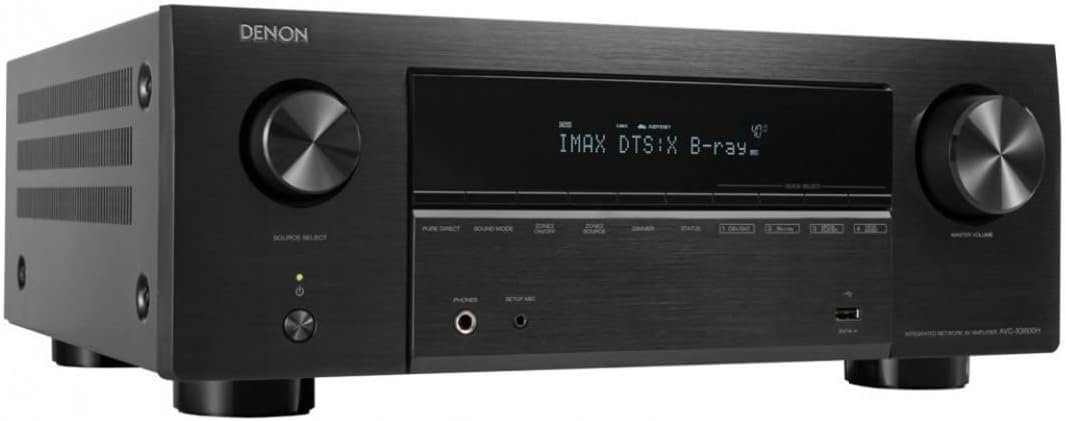
An AV receiver is the switchboard of a home cinema. Everything that makes a picture or a sound plugs into it — Blu-ray player, satellite or cable box, games console, streaming apps — and it decides what comes out the other side, decoding surround formats into actual room sound and passing video through to a television or a projector. It is the one box in the chain that sets the ceiling on what the whole system can ever do, which is why it is worth more thought than the speakers.
From a tested field of 48 receivers, here is how to choose one.
Count the amplifier channels first
This is the specification that caps everything else, and it is the one most buyers skip past.
Seven amplifier stages is the entry point, and it drives a 5.1.2 Atmos or DTS:X layout — five speakers at ear level, a subwoofer, two height channels. That is a genuine home cinema and it is enough for most rooms. What seven stages generally will not do is run a second room at the same time.
Nine stages is where the flexibility arrives: a larger installation plus a second stereo zone elsewhere in the house, driven simultaneously.
Thirteen stages across fifteen speaker terminals is the top end. At that point you are configuring rather than compromising, and running a full cinema layout alongside at least one stereo zone stops being a trade-off at all.
Work out the layout you want in the room you actually have, then buy the channel count that serves it. Adding speakers later to a receiver that cannot drive them is the expensive mistake in this category.
Room calibration is the feature that does the most work
Every recommendation here ships with automatic room measurement, and it matters more to the final sound than most of the specification sheet. A measurement microphone and a stand come in the box; the receiver plays test tones and sets levels for the acoustics of your room and the size of your speakers.
The best implementation in the field is Audyssey MultEQ XT32, the most extensive version of that system. It is worth knowing what the setup routine catches: as well as confirming that each speaker is plugged into the right terminal, it identifies a speaker wired in reverse polarity — genuinely useful, because with that many binding posts in a row it is easy to get one pair backwards, and the symptom is simply that the sound is vaguely disappointing rather than obviously broken.
The picks
Best overall — Denon AVC-X3800H. Nine amplifier stages, enough for a large installation with a second stereo zone on top. Six HDMI inputs feed up to three outputs, one of which can serve a second video zone, and HEOS is built in for streaming and multiroom.
Setup is unusually well handled for a category that is notorious for it. Denon lays the speaker terminals out in a single row rather than stacked pairs, colour-codes them as well as labelling them, and runs a full-text help system through first installation. The remote's buttons illuminate, which matters in a darkened room. App control works too, but only if you enable network control during that first setup — worth knowing before you pack the box away.
On sound it handles essentially every current audio and video format, including uncompressed FLAC and DSD at up to 5.6 MHz, so hi-res streaming tiers are covered. The phono stage is properly good rather than a token inclusion — unsurprising from the company that still makes the DL110 cartridge. Even driving just one pair of Atmos speakers, bounced off the ceiling from atop the front pair, the spatial effect is excellent; rain genuinely comes from above. In a 5.1.4 configuration it will drive four Atmos-capable speakers in any position, including front-wall height speakers that Dolby's specification does not really provide for — the calibration accounts for them anyway.
Drawbacks are thin on the ground. Upscaling from Full HD to 4K or 8K is handled well, though a recent television or projector may do just as good a job itself. The Android remote app remains the weak link. There is no DAB or FM tuner, which is easier to forgive given the built-in internet radio. And there are no analogue video inputs at all.
If you have legacy video sources — Onkyo TX-RZ30. Also nine amplifier stages, with the major streaming services preinstalled. Its distinguishing feature is three analogue video inputs, which is exactly the reason to choose it: if you still have equipment that predates HDMI, most modern receivers simply will not accept it.
If a full-size receiver will not fit — Marantz Cinema 70s. The case is half the height of most of its competitors, which solves a real problem when a conventional receiver is either too large for the shelf or too ugly for the room. Seven amplifier stages give you a 5.1.2 layout with 3D sound, multiroom and streaming are present, and the room correction is the same as on the bigger models. It also has an FM tuner with RDS. One limitation: its second zone works only in active mode.
For the biggest rooms — Denon AVC-A10H. Thirteen amplifier stages across fifteen speaker terminals, handling more or less anything you give it, and open to Auro-3D as well as Dolby Atmos and DTS:X. Despite the scale, setup stays comprehensible for a non-specialist. It is extremely heavy.
Best entry point — Denon AVR-X1800H. Seven stages, comfortably driving a 5.1.2 Atmos or DTS:X set, with all the common audio and video formats supported and a simple installation. Its limit is the one described above: no second stereo zone. For a first home cinema that is rarely the constraint people think it will be.
The HDMI 2.1 fault worth knowing about
This one is genuinely important and rarely mentioned. HDMI 2.1 brought 4K at 120 frames per second and 8K at up to 60 Hz with full colour resolution and HDR, and it required new silicon — silicon now used in most current AV receivers. That chip shipped with a production fault.
In practice it shows up mainly when gaming on an Xbox Series X, and in combination with an Nvidia RTX 3080-class graphics card. The PS5 is reported to be unaffected.
The part that matters when you are buying: it cannot be fixed by a firmware update. It is a hardware fault, and the remedy is a hardware one — some manufacturers, Yamaha among them, have offered a free hardware upgrade where units are available. If you are buying specifically to drive a high-frame-rate console or PC, ask about it before you order rather than after.
Second zones and multiroom
Most receivers here have enough amplifier headroom to feed a second room in stereo while the main room runs surround — the constraint is usually whether speaker cable already runs to that room, not the electronics.
Wireless multiroom is handled by a manufacturer's own protocol: Denon HEOS, Yamaha MusicCast, FlareConnect, normally running alongside AirPlay and, in some cases, Sonos. That is a lock-in worth noticing, because it is easier to add speakers from the same family later than to mix them.
On video, all the current models pass 4K, 8K and HDR through untouched, covering HDR10, HDR10+, Dolby Vision and HLG, and will upscale standard-definition sources to Full HD or 4K — the newest to 8K.
Model numbers, and two traps
Denon splits its range across AVC- and AVR- prefixes, and both appear in UK listings, so the letters are part of the model name rather than a typo. The AVR-X1800H is also sold as the AVR-X1800H DAB, a version with a DAB+ tuner built in for a small premium — a variant that is more relevant here than in most markets.
Watch the Marantz naming too. The Cinema 70s is the 7.2-channel AV receiver described above. The Stereo 70s sits next to it in search results at a similar price and is a different product — a stereo receiver, not a home-cinema one.
Availability here
Both the Marantz Cinema 70s and the Denon AVR-X1800H are listed and in stock on Amazon UK, as is the Sony TA-AN1000 from the wider tested field. The Denon AVC-X3800H is catalogued in the UK — the exact 9.4-channel model — but at the time of checking it had no active buy box, so it is a model to search for across retailers rather than assume is a click away.
Before you buy
Four questions. What speaker layout do you want in two years? Buy the channel count for that, not for today. Do you need a second room? If so, seven stages will not do it. Do you have anything older than HDMI? Then analogue video inputs move to the top of the list. And will a console or gaming PC drive it? — in which case read the HDMI 2.1 section again before ordering.
A receiver exists to feed a display, so it is worth deciding both together: our best 4K TVs, best OLED TVs and best projectors guides cover the other half of the system. If voice control and multiroom music matter more to you than surround sound, a smart speaker may be the better purchase entirely.