Fitting, maintenance and spares
Workshop vices are bolted permanently to a solid bench or worktop. The plate wants to be as torsion-resistant as possible and 30 to 40 mm thick, and the fixings are bolts in the size the manufacturer specifies, plus washers and self-locking nuts. Some vices include their mounting bolts. If there is no fixed workplace, a clamp-on vice with an integral screw clamp attaches to a worktop in seconds and comes off just as quickly.
When a vice grows stiff over time, a thorough clean is often all it needs, after which the spindle and guides are greased to the manufacturer's specification. A vice with an adjustable guide can have any developed play taken up. Good manufacturers still supply jaws, spindles and guides many years on, along with accessories such as protective jaws, pipe jaws, turntables, folding systems and risers. With many cheap imports you will look for those spares and accessories in vain.
The picks
Top pick — Brockhaus Heuer 100120
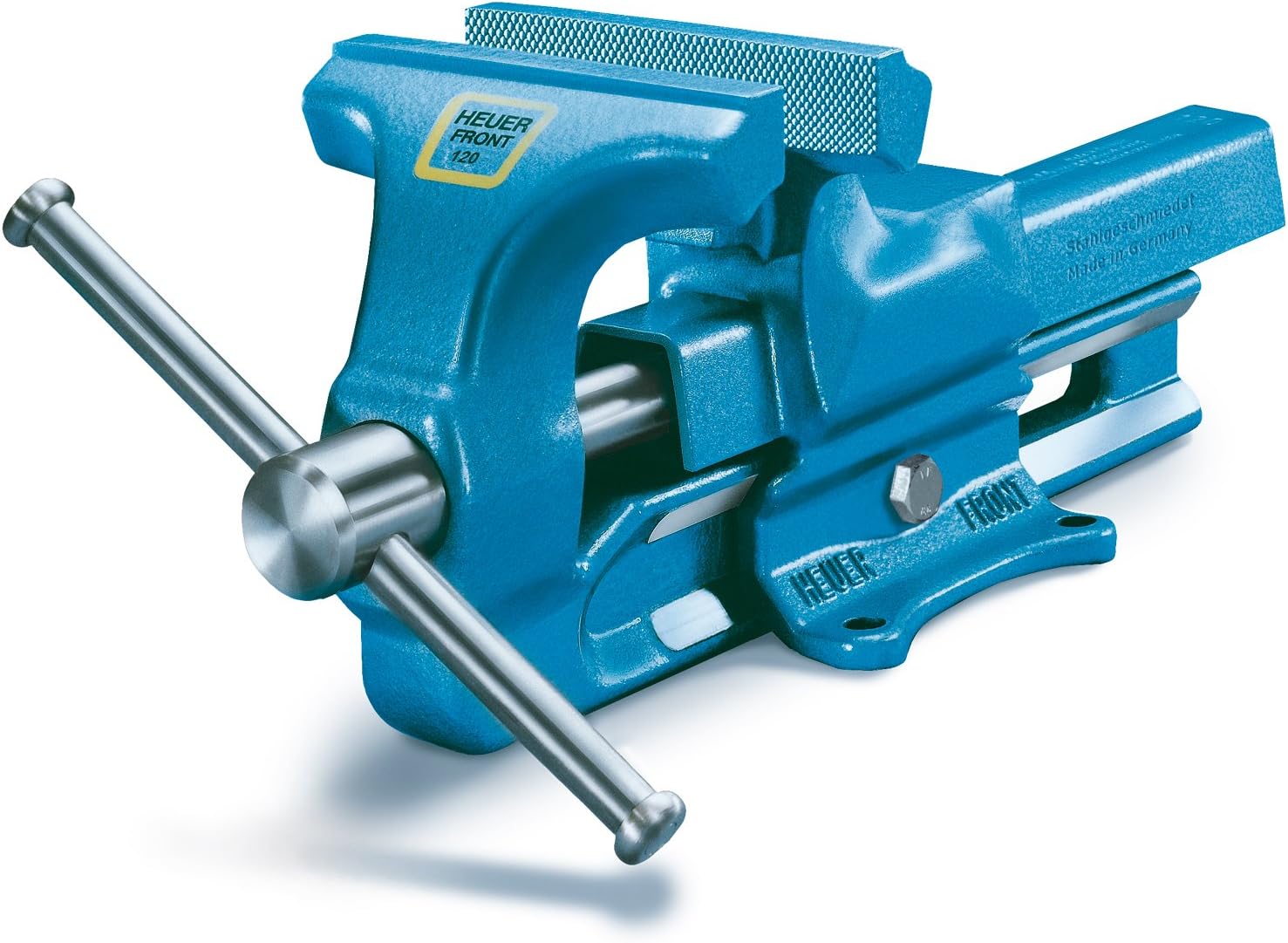
The best bench vice for most home workshops. The test model has 120 mm jaws and a generous 150 mm capacity, and it is a genuine classic: the parallel-vice design was patented in 1925 and it is still built in Germany. It is forged steel under blue hammer-finish paint and weighs 9 kg, with four mounting holes in the base plate. The trade supplies plenty of accessories for it, protective jaws and turntables among them, and spare parts for almost the entire range.
In practical work it convinced thoroughly. Workpieces clamped precisely and exactly, and wide workpieces were no problem either. Unlike many of the other candidates, the front jaw does not wobble when the vice is wound well open, and a spindle stop prevents the front jaw dropping out of the guide at maximum opening — a feature many heavy vices simply do not have. All the sawing and drilling tasks were completed to full satisfaction. The slim build lets long workpieces be clamped vertically, and even loaded on one side like that the jaws still stood exactly parallel to each other. Bending a clamped flat bar was managed without a mark on it, and it was not treated gently during that test.
The one grumble is the anvil plate, which could stand to be a little larger, and testing it left a few chips in the paint.
Overall it is an all-rounder in professional quality that an ambitious home worker who uses a vice often can hardly go wrong with: nine kilograms of forged steel, top build quality and a wide range of uses.
Search Amazon UK · Search Amazon US
The professional's choice — Kiesel Werkzeuge Leinen Parallel-Schraubstock Junior 125
If you want something that works equally well for the ambitious amateur and the professional, this is the address. The green Junior weighs almost 25 kg and is properly, satisfyingly massive; treated with care, it is the kind of tool that gets handed down. It arrived well packed in a sturdy carton, and the green hammer-finish paintwork is superbly applied.
Mounting is the one thing to plan for. There is a single fixing hole at the rear and two more at the front, and unlike most vices these are arranged so the bolts go into the front face of the bench rather than down through the top. The bolts are 8 mm thick, so the bench needs sufficient thickness for that: the test model went securely onto a 4 cm worktop, though 5 cm would be better still. A turntable is available as an accessory to make it rotate through 360 degrees, and it also simplifies fitting because nothing then has to be screwed into the front face — at a significant extra outlay.
The body is high-strength solid grey cast iron and the vice opens rearwards. It winds open and shut smoothly and runs cleanly in precisely machined dovetail guides, and the spindle guide is well protected. Even wound wide open the guide behaves impeccably and shows no play at all. Capacity is a considerable 175 mm.
A wide multiplex board clamped absolutely solidly for drilling. Workpieces are held by 125 mm jaws fixed with two cross-head screws each; the jaws have a serrated face and a smooth face and can be fitted either way round as required. A jaw lock additionally stops them loosening or shifting under heavy force.
Every adjustment worked perfectly in practice, which is what marks the Junior out as a professional tool. It does good service equally at simple sawing, drilling and bending in wood or iron and at hard, heavily loaded metalworking, and every kind of workpiece was clamped securely and exactly. The anvil face is large enough for a wide range of work on it.
The honest caveat is that anyone who only occasionally reaches for a vice does not need this much: the somewhat lighter top pick will do. Anyone who likes working with professional-grade equipment will not go wrong with it, and used properly it will last indefinitely.
Search Amazon UK · Search Amazon US
Small, mobile and endlessly adjustable — Stanley MaxSteel 1-83-069
A small clamp-on vice that catches the eye immediately in matt yellow with black spindle keys. Design is no buying criterion for a vice, but it does set this one apart from a field of blue hammer finish.
What matters more is what it is made of, and that stands up well. The yellow castings are cast iron with excellent paintwork, and the steel jaws carry a V-groove that holds pipe nicely. A jaw width of 70 mm is notable on a vice weighing just 1.6 kg, and the measured capacity of 70 mm is decidedly generous. It ships with removable rubberised jaw caps that protect delicate workpieces well.
The key feature is the ball joint, which lets it turn through 360 degrees. That multi-axis movement makes it a genuine all-rounder for the hobbyist, because the vice can be fixed in any position across three axes. It attaches to a bench through an integral screw clamp fitted with rubber caps that protect the worktop from above and below, and the worktop may be a maximum of 60 mm thick.
In practice, fitting to the worktop was straightforward and it clamped securely, though the bearing area on the worktop could stand to be a little larger. The first task was sawing a 10 mm threaded rod, clamped between the rubber-protected jaws, which held it superbly — the thread showed no damage at all afterwards. A square tube and a wooden batten both clamped rock solid and worked well, and it coped with downward pressure while drilling metal. Only bending a flat bar found its limit, which is fair enough for a vice this size faced with a bar of that thickness; thinner flat metal it will bend perfectly well.
The single noted shortcoming is the unprotected spindle. Sawing and drilling drop swarf straight onto it, and it wants brushing off before the next job.
It cannot replace a bench vice, and by design it lacks a proper anvil, but it is the perfect answer for smaller DIY work, ideal on site or in a camper, and it fits in any toolbox.
Search Amazon UK · Search Amazon US
The value pick — Vevor 6 Bench Vise
For a solid home-workshop vice without digging deep, this is the one to look at: an overall convincing bench helper with small weaknesses that the value on offer makes easy to overlook.
It arrives with magnetic protective jaws and mounting bolts, and according to the manufacturer a drilling template, which was not in the carton. The supplied bolts only suit thin bench tops of up to around 2.5 cm; a thicker worktop means sourcing longer bolts, or cutting threaded rod to length and fitting nuts.
It looks the part, with an orange powder-coated base plate and grey hammer finish on the rest of the housing. Small paint chips on the underside of the base plate and slightly uneven paintwork elsewhere take a little off that impression, though neither affects how it works.
Technically it is thoroughly sound. The spindle guide gives an even, dependable action, and the 152 mm jaws are bolted on and can be swapped or realigned as needed — a sensible detail that is not a given at this level. A capacity of 150 mm covers most classic home-workshop jobs, and four bolts through the base plate hold it securely to the bench. The clear minus point is the absence of a spindle stop: the moving front section can come out of the guide if the vice is wound too far open. It rotates through 360 degrees and locks with two clamping levers, which could usefully be a little longer.
In practice it proved stable and dependable, with ample clamping force. Wooden battens clamped and sawed well, sheet metal was bent cleanly over the jaws, and threaded rod cut to length in the magnetic rubber protective jaws came out with its thread intact. Pipe can be clamped conveniently below the jaws, which widens what the vice can do; square section or round tube, whatever went between the jaws was held well.
It is not a precision instrument for industry, but it is exactly right for anyone who wants to saw, bend or shorten reliably. If you can live without the spindle stop, it is a solid piece of bench equipment.
Search Amazon UK · Search Amazon US
Also tested
Brüder Mannesmann M 713-050 — a small clamp-on vice, rotatable through 360 degrees, opening rearwards, with a small anvil face integrated despite its modest dimensions. The bearing area for clamping to the worktop is too small and the lower part of the clamp sits very close to the worktop edge; trying to bend a flat piece of metal, the vice worked loose and threatened to slip off the bench. Horizontally clamped workpieces such as square bar and round tube were held firmly by the unbolt-able jaws. Fine for smaller craft jobs, but it does not come close to the small yellow Stanley clamp-on. Search Amazon UK · Search Amazon US
HRB Robuster Schraubstock 100 mm — jaws 100 mm wide, capacity 120 mm, the same as the larger HRB, which is respectable. The integrated anvil on the test sample was poorly deburred and had sharp edges, but the blue hammer-finish paintwork is first rate. Test workpieces clamped securely and firmly for saw and cordless drill, and it passed the flat-bar bending test. The spindle was stiffer than the big HRB's and made a grinding noise. Given how little separates the two HRBs, the larger version is the one to have. Search Amazon UK · Search Amazon US
HRB Drehbarer Schraubstock 50 mm — a clamp-on model identical in construction to the Brüder Mannesmann. With 50 mm jaws it is neatly painted, though the jaws are not well deburred. For occasional small craft jobs where a third hand is needed it serves its purpose; for anything bigger the workshop needs a sturdier colleague. Ideal for the road and it fits any toolbox. Search Amazon UK · Search Amazon US
Meister 5142500 — a disappointment. The rotatable Meister has 75 mm jaws and 75 mm capacity, and the jaws sit slightly offset when closed with nothing clamped, and are not flat. That is liveable, but it showed weaknesses after the flat-bar bending test: the spindle key became hard to turn and the spindle no longer ran cleanly in the nut. Unbolted from the bench, the spindle nut turned out to be loose. A small repair got it running reasonably again, but not satisfactorily, and the bolted-on spindle screw is a design flaw. The supplied plastic protective jaws and the well-functioning rotation mechanism are the positives. Search Amazon UK · Search Amazon US
Nuovoware P723314082370 — a clamp-on vice opening rearwards, with rubberised protective jaws and protective caps for the clamp, so it leaves no marks if it has to go on a kitchen table. The mini anvil is a useful gadget and took a few hammer blows well. At 70 mm the jaws are distinctly wider than similar rivals and capacity is a larger 75 mm, but in practice it could not lift itself above the other cheap clamp-on vices, holding workpieces about as well while they were sawn and drilled two-handed. A larger bearing area would help, and points come off for the partly painted inner faces of the jaws. Search Amazon UK · Search Amazon US
Stanley MaxSteel 1-83-065 — a mid-size grey cast-iron table vice weighing just under 5 kg, well packed, but with black paint blotches straight out of the box. It bolted securely to the worktop through four well-placed mounting holes. Rotation was a little sticky though the lock worked well, and although the spindle guide and moving section had some play and wobbled, workpieces still clamped firmly, if with some judder when winding open and shut. Jaw width of 100 mm and capacity of 85 mm are fine for its size. There is no spindle stop, and the unprotected spindle quickly fills with sawdust and dirt. Search Amazon UK · Search Amazon US
Röhm Bohrmaschinen-Schraubstock Typ BSH-5 — not a classic bench vice but a machine vice for holding pipe and flat bar on a pillar drill, and its jaws are its strength. Pipes clamped firmly in the horizontal prism of the 100 mm wide, 40 mm high jaws, and the three vertical prisms hold pipe well too, while an angled notch in the upper part of the jaws handles flat material horizontally. The spindle pin is only pushed in, retained by a knurled band in its middle, which is not the best solution; a fixed pin would be preferable. Build quality and the smooth action of this 7 kg heavy-duty version are good. It fits only larger drill tables, needing a 30 x 25 cm footprint, and at a pinch it can be fixed to a bench, but as a permanent classic vice it is unsuitable. Search Amazon UK · Search Amazon US
Flexmo Parallel Schraubstock 100 mm — a non-rotating forged cast-iron model with 100 mm jaws weighing around 7.5 kg, well packed, with faultless grey hammer-finish paint and no sharp edges. It fixes to the bench with two bolt holes, though the mounting bolts listed on the packaging were missing. Despite a spindle guide that is protected from dirt and almost over-greased, it took more effort to wind open and shut than the top pick or the Leinen, while staying simple and dependable to handle. It clamps varied workpieces securely and, importantly, in parallel, the guide has no play, and the anvil is compact but big enough. Both serrated jaws and the pipe jaws unbolt and can be swapped. Its small dimensions suit a small bench or mobile use, in a tradesman's service vehicle for instance. Search Amazon UK · Search Amazon US
Stanley Schnellspann-Klemmstock 0-83-179 — not a classic clamping tool but a mobile holding aid: light, compact and toolbox-sized. One-handed use is the standout — once you know the mechanism, a downward lever movement pushes the slide forwards and clamps the workpiece. Clamping force naturally does not reach that of a classic vice; enough for light holding work, not for bending sheet or heavy clamping. Drilling into a batten works well provided you stay near the clamping point, because at greater distances leverage lets the workpiece shift between the jaws. Capacity of around 115 mm and a clamping depth of about 80 mm give a surprisingly broad range, recesses in the jaws hold round workpieces such as pipe or threaded rod, and push-on rubber jaws protect delicate materials. It fixes with two sliding screw clamps, which did not run cleanly in their grooves and were sticky to adjust. Search Amazon UK · Search Amazon US
Brockhaus Heuer Parallelschraubstock Compact 120 — supplied as a cased set, padded securely, with four different protective jaws included. It is genuinely compact at just 4.8 kg yet brings remarkable clamping force and holds workpieces securely. The supplied table clamp allows quick, secure mounting on worktops up to 60 mm thick. The Quicklaunch quick-adjust is the fun part: instead of long winding, one button press sets the jaws steplessly out to a 125 mm capacity, with a scale to help, and it saves real time when workpieces vary in size. The four magnetic protective jaws for pipe or delicate work are a genuine plus. In practice it is a well-thought-out helper, fitted and ready in seconds, and a flexible alternative where the workplace changes or the bench has no room for a permanently installed vice. Search Amazon UK · Search Amazon US
Tectake 800167 — near enough the twin of the HRB 125 mm in shape and dimensions, with a 360-degree turntable, exchangeable jaws and an anvil face of roughly 60 x 65 mm. Unpacking reveals a noticeable film of dirt and oil to be removed before first use, plus a few sharp-edged spots that file away quickly but should not be there on delivery. In everyday lighter work it is dependable: the spindle runs properly, the jaws close evenly, and around 125 mm of jaw width with the usual equipment meets the needs of occasional home-workshop jobs. Under harder use, bending thick sheet or applying large forces, the construction is simply not robust enough. Search Amazon UK · Search Amazon US
Trutzholm Parallelschraubstock 200 mm — grey cast iron, a hefty 18 kg, with well-executed blue hammer-finish paint and three mounting holes that fixed it to the bench without trouble. It rotates through 360 degrees, though the two levers for locking the turntable are a little short to tighten properly. The 20 cm jaw width stands out and the jaws hold up well even loaded on one side, which cannot be said of the wobbly guide of this front-opening vice. With its large 14 cm capacity, that jaw width and a large anvil face it is well suited to occasional work at home; for continuous use and harder jobs it is not the recommendation. Search Amazon UK · Search Amazon US
Küpper Profi-Schraubstock 125 mm — it impresses before it is even out of the box, sitting exactly in a sturdy polystyrene moulding, better protected in transit than almost anything else here. A clear fitting guide covering several mounting options is included along with two M10 bolts, nuts and washers, though at 55 mm long they are a little short for the 30 to 40 mm worktops common in home workshops. The body is forged steel, black-painted and designed for high loads, the 125 mm jaws suit most home-workshop work and the 125 mm capacity works well day to day. Equipment includes a large anvil face, an integrated pipe-clamping arrangement and two screws for taking up play in the guide, and the substantial 27 cm tommy bar gives a strong lever for clamping with high force. In practice it holds wood and metal reliably, the workpiece does not shift while sawing or drilling, and the spindle runs easily. It gives away few weaknesses; jaws that do not close quite parallel and those short bolts cost it a few points. It closes the gap between cheap hobby vices and far dearer professional models for anyone who can do without a turntable and exchangeable jaws. Search Amazon UK · Search Amazon US
BGS 58112 — a forged steel body and just under 11 kg aimed at anyone wanting something more massive. The large anvil face gives plenty of room for hammer work and a 15 cm capacity takes bigger workpieces, and it rotates through 360 degrees with a well-greased spindle. The manufacturer quotes 125 mm jaws; the test sample measured around 140 mm. Closer inspection is less kind: paint runs and unevenness, weld spatter, sharp edges and metal burrs, and exchangeable jaws that are very coarsely serrated and not cleanly deburred, so delicate workpieces quickly pick up pressure marks. The jaws do not close parallel — visible by eye and confirmed by clamping a sheet of paper, which grips on one side and pulls out on the other. Despite the greased spindle it runs stiffer than rivals, and the comparatively thin tommy bar looks undersized for the mass of the vice. The tommy bar fixing draws criticism too: the locknut thread is cut untidily, so it worked loose repeatedly during testing and eventually fell off altogether. It does its job and the forged body takes heavy loads, but build quality and precision do not match its billing. Search Amazon UK · Search Amazon US
Gedore 409 — notable for a square mounting plate 1 cm thick, joined to the body with substantial welds, and two bolts with nuts and washers included, though again too short for the 40 mm worktops common at home. The blue hammer-finish paint is cleanly applied and the roomy, induction-hardened anvil plate gives space for straightening and forming work. The manufacturer quotes 100 mm jaws; the test sample measured around 110 mm, and nobody is likely to complain about the extra centimetre of clamping face. The stated 120 mm capacity is fully usable, but no further: there is no spindle stop to prevent winding right out, and wound too far the moving front section comes clean out of the guide. In practice it does its work reliably, clamping wood and metal securely and holding it while sawing and drilling. Less impressive is how the jaws close — not quite parallel, shown again by the paper test gripping on one side and pulling free on the other. The jaws are fixed to the body and cannot be exchanged, and the test sample had sharp-edged bare patches on the right-hand jaw, with packaging and carton undamaged, so transit damage looks unlikely. Search Amazon UK · Search Amazon US
How they were assessed
Before the vices went to work, each was checked over. Capacities and jaw widths were measured, build quality inspected and the mounting checked. All the vices were fitted under comparable conditions, with matching bolts, nuts and washers, to a 40 mm thick bench top.
Then came the practical part. Various workpieces were clamped — a square section, a round tube and a wooden batten — each of them vertically, centrally and horizontally across the full clamping face, watching how securely the material was held and whether the jaws closed cleanly parallel. For the parallelism check a sheet of paper was clamped between the closed jaws to see whether it was gripped evenly across the whole jaw width, and the jaws were also watched for differing behaviour under load.
Sawing and drilling show whether a workpiece shifts, so wood and metal workpieces were cut with a hand saw and deliberate downward pressure applied while drilling. A bending test was part of the programme too, with a flat bar bent through 90 degrees to show how well each vice absorbs heavier loads. Differences by construction are to be expected there: a 2 kg clamp-on vice cannot match a massive workshop vice in that discipline.
Exact measurement of clamping force was not possible in the test environment, so it was judged from the practical tasks and above all from how securely workpieces were held under load. Alongside holding power, operation was assessed in the practical work: how easily the spindle turns, how the jaws move across the whole clamping range and whether the guide runs evenly, with any play and the handling of the tommy bar feeding into the assessment.
The short answers
Which bench vice is the best? The Brockhaus Heuer 100120 is the best for most home workshops — massively and precisely made, an all-rounder in professional quality that is hard to go wrong with. Other vices in the test convince as well.
What can you do with a bench vice? Clamp workpieces firmly and then work them with both hands. Sawing, filing, grinding, drilling and bending are the usual jobs.
Which jaw width should you choose? It depends first on what you intend to work on, but a good all-round vice should have jaws at least 120 mm wide. As a rule, the wider the jaws the greater the capacity, and that opening width is a decisive figure in itself.
Which grease should you use on the spindle? Clean the spindle regularly and then grease it with a multi-purpose grease. The guide rails can be brushed with a slideway oil.