A sports watch and a smartwatch carry many of the same sensors. The difference is how much further the sports watch takes each of them — and that, rather than the badge, is what you are paying for.
What the sensors actually gain you
Location. A phone or basic smartwatch gives you GPS. A sports watch gives you multi-GNSS — using every satellite constellation rather than the American system alone — and the better ones add dual-frequency reception for accuracy down to the metre whatever the environment. That is the difference between a trace that follows the path and one that cuts corners through buildings and tree cover.
Heart rate. Considerably more precise on a sports watch, and precision is the whole point: you need to know which zone you are in, including during interval work where the rate swings quickly. Combined with the accelerometer, altimeter, pulse oximeter and temperature sensor, that produces information you can actually train against rather than merely review.
Training, not just recording. This is where sports watches separate themselves. Some carry virtual coaches; most let you build sessions or import training plans. Good software shows your progression, your limits and — the one people underestimate — your recovery. The best also carry mapping, so you can follow a route without taking your phone out.
And they remain smartwatches: contactless payment, music, third-party apps, phone calls, even an LED torch for emergencies.
Finally, two practical constraints: it must be comfortable enough to wear all day, which means controlled weight, and robust enough for whatever you actually do.
What each tier buys you
The market has become genuinely competitive again. Coros and Suunto are unsettling Garmin, competing both on price and on being simpler to use, while the top of the range has pushed into titanium cases.
The tiers are unusually well defined:
- Entry level emphasises lightness, battery endurance and the essential sensors for your sport. Nothing decorative.
- Mid range is where you gain an AMOLED screen and mapping — the two upgrades most people actually feel.
- Upper tier is about robustness, and about software pushing further into statistics and analysis.
Read that list before deciding a budget. If you do not need mapping, the mid tier is not buying you much; if you do, it is the single biggest jump in the range.
Entry tier — lightness, battery and the basics
Decathlon Fit 100 is the value proposition of the whole guide: a 42 mm case weighing 41 grams at 10.8 mm thick, with built-in GPS, an AMOLED screen and five days of battery, running on Decathlon's own Hub app. The design has not been neglected either — simple, discreet and tidy, with a practical hook-and-loop strap that adjusts quickly.
Coros Pace 3 is where the newer brands make their case. It is slightly dearer than Garmin's entry model but newer and offers more: a 42 mm case, 11.9 mm thick, and remarkably light at 37 grams — or 30 grams with the nylon strap. That matters more than it sounds; it is genuinely hard to choose another watch if your priority is comfort and the sensation of not wearing anything at all. Battery runs five to seven days with around ten hours of training a week and dual-frequency positioning switched on, which is the demanding configuration rather than the flattering one.
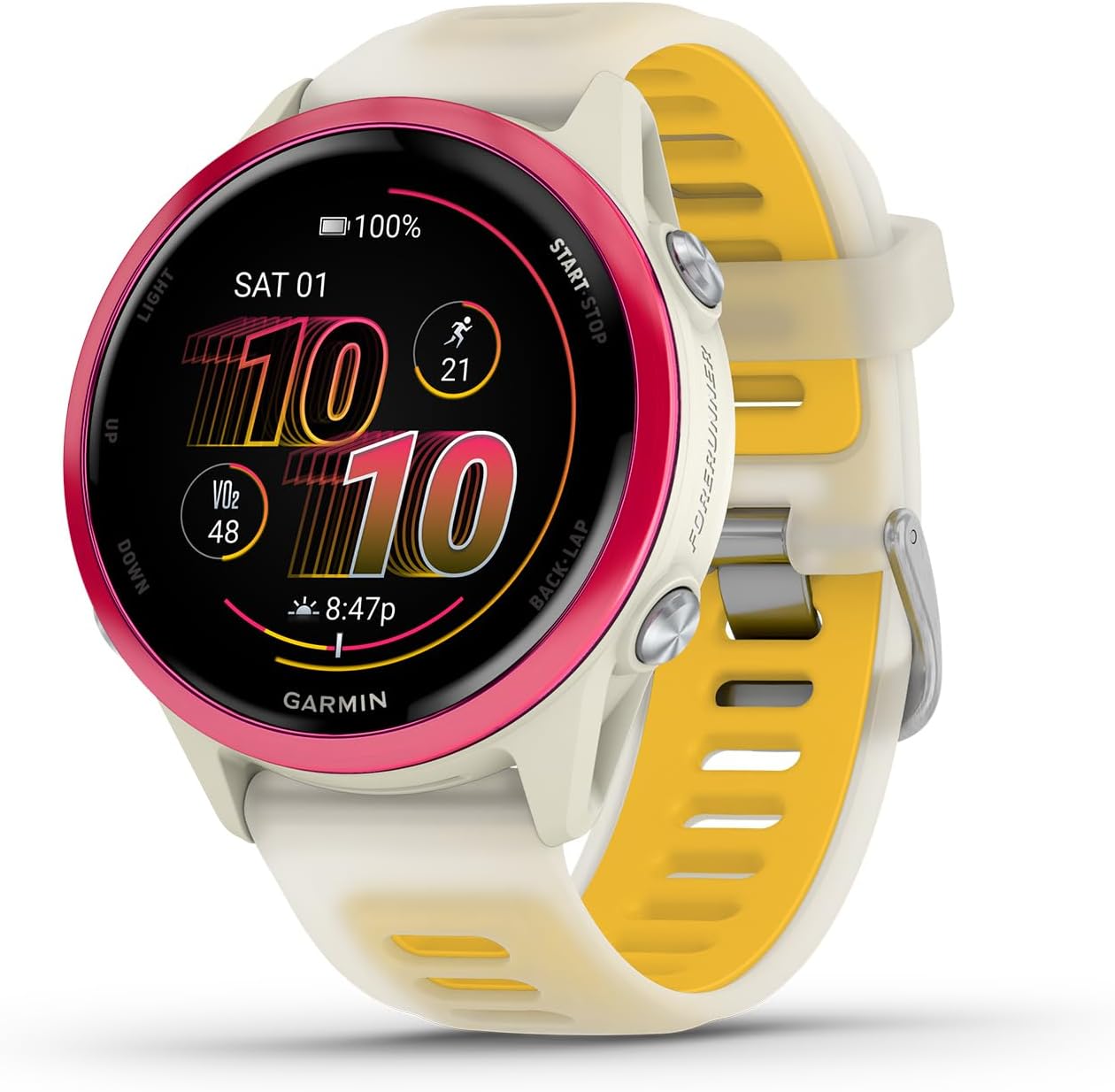
Garmin Forerunner 55 — 42 mm, 37 grams, 11.6 mm thick — launched three years ago and still Garmin's cheapest sports watch. It earns its place by being the safe, known quantity at this level rather than the most exciting.
Huawei Watch FIT 5 Pro delivers qualities you would not expect at this level: a titanium bezel and sapphire glass, giving it robustness normally reserved for far dearer watches. Its 1.92-inch LTPO display is fluid and exceptionally bright, which keeps it readable in any conditions.
Mid tier — AMOLED and mapping
This is the tier most runners should look at first, because mapping and a bright screen change how a watch is used day to day more than extra analytics do.
Coros Pace Pro is the standout. Coros's first AMOLED watch, in a 46 mm case at 37 grams and 11.7 mm thick — and despite the power-hungry screen it returns roughly two weeks of battery, which is the sort of figure that reshapes a category. It carries the mapping from Coros's more expensive models.
Suunto Race is the opposite proposition and none the worse for it. Available at 49 mm or 45 mm as the Race S, it weighs 83 grams at 13.3 mm — not discreet and not light, which is plainly deliberate given the polished metal crown. What it is: a mature GPS sports watch, accurate whatever the sport, with a particularly strong companion app.
Amazfit T-Rex 3 Pro — 48 mm, 52 grams, 14 mm — is Amazfit aiming at watches costing twice as much, and doing it with a sapphire glass screen and titanium bezel rather than software promises.
Huawei Watch GT Runner 2 is the lightweight of this tier at 34.5 grams in a 43.5 mm case just 10.7 mm thick, and it carries very nearly everything a serious runner expects — hardware and technical performance that need not apologise to dearer rivals.
Garmin Vivoactive 6 — 42 mm, 36 grams, 10.9 mm — is the deliberately discreet one. Unlike the rest of Garmin's range it is aimed at people who want a lifestyle watch that happens to train properly, rather than a training tool they must also wear to dinner.
Upper tier — robustness and depth
Titanium construction is common here, and the software is where the money goes — ever deeper statistics, analysis and recovery guidance.
Garmin Fenix 8 is the reference point: Garmin's most robust and most advanced watch, in three case sizes with a meaningful weight spread. At 43 mm it is 66 grams in stainless steel or 60 grams in titanium, both 13.8 mm thick; at 47 mm, 80 and 73 grams at the same thickness; and at 51 mm, 102 or 92 grams at 14.7 mm. Choosing the case size is therefore also choosing roughly forty grams of wrist weight, which matters if you sleep in it.
Amazfit T-Rex Ultra 2 is the one for going properly off-road: 50 mm, 89.2 grams, 14.3 mm, with build quality and a wide, exemplary-legibility screen — and dual-band GPS described as surgically precise.
Garmin Venu X1 is the outlier at just 7.9 mm thick in a 46 mm case weighing 40 grams. It is frankly an Apple Watch in its design language, which is either the appeal or the objection depending on your view.
Garmin Forerunner 570 improves meaningfully on the Forerunner 265 it replaces. It comes in 42 mm (42 grams) or 47 mm (50 grams), both 12.9 mm thick — and it is listed on Amazon UK in the 42 mm form, so check which case size you are ordering.
Apple Watch Ultra 2 — 49 mm, 61.4 grams, 14.4 mm — is everything Apple does best in a robust body genuinely capable of competing with a Fenix 8. Its screen is brighter than that of its sport-focused rival.
Samsung Galaxy Watch Ultra 2 is 47 mm and 61.5 grams, but the number that matters is thickness: its titanium case is planed down to 10.7 mm, and the comfort gain is noticeable during long efforts. The panel is Super AMOLED.
Before you buy
Four questions. Do you need mapping? It is the clearest reason to move up a tier, and the clearest reason not to. Do you train by heart-rate zones? If so, sensor quality matters more than screen quality. Will you wear it all day and overnight? Then weight and battery endurance outrank everything else, which is why the entry tier suits more people than its price suggests. And which ecosystem are you in? — the Apple and Samsung options are excellent watches that work best inside their own worlds.
If you want a general smartwatch rather than a training tool, our best smartwatches guide covers those, and best fitness trackers covers the lighter, cheaper end.