Waking with a dry throat, cracked lips or itchy eyes usually points at one thing: the air indoors has lost its moisture. It is rarely just the weather. Central heating in winter and air conditioning in summer both pull water out of a room, and once the level drops far enough it starts to show in your sleep, your skin and your breathing. A humidifier puts that moisture back. Below are the models worth considering, from a compact unit that costs very little to a 7.5-litre tank that can run for days, along with the numbers that actually decide which one suits your home.
The Short Version
- Cecotec Pure Aroma 300 Yang — compact, discreet and basic, with aromatherapy and seven LED colour effects.
- LEVOIT 3L Top-Fill — a very complete ultrasonic model with an excellent balance of quality and price.
- Cecotec BreezeCare 4000 Connected — a 6-litre tank and a plasma function that clears stale odours.
- SPC Sedna — a 4.3-litre tank and up to 10 customisation modes.
- Winix L500 — a 7.5-litre tank with runtime of up to 120 hours.
- Philips Series 3000 HU3918/10 — humidifies and cleans the air, with a quiet night mode.
What Counts As Healthy Humidity At Home
Humidity is simply the amount of water present in the air. It shifts with temperature and air movement, but everyday activities push it around too — breathing, cooking, showering, exercising and drying laundry indoors all add moisture. Spanish building regulations for thermal installations set the sensible indoor range at 40 to 60% relative humidity: in winter, 21-23 ºC paired with 40-50% humidity; in summer, 23-25 ºC paired with 45-60%.
Straying outside that band has consequences in both directions. Too much moisture encourages bacteria, viruses, fungi and mould, which affects the people in the house as well as the furniture, the paintwork and eventually the building itself. Too little dries out the mucous membranes and the throat, which is exactly the symptom most people notice first. If your home tends towards damp you want the opposite appliance — see our best dehumidifiers guide — but if the air runs dry, a humidifier is the fix.
Cecotec Pure Aroma 300 Yang
Compact, discreet and deliberately basic. This is an ultrasonic humidifier with a 300 ml tank, around six hours of runtime and a timer, drawing only 10 W. Alongside the moisture it doubles as an aroma diffuser and can light the room with seven different LED colour effects, which makes it as much a bedside object as an appliance.
It is the cheapest way to improve the atmosphere in a single room and add a little humidity where you sleep. The catch is that the output power cannot be regulated, so you get one mist setting rather than a choice. For a small bedroom, a desk or a nursery corner that is usually enough; for anything larger, look further down this list. Search on Amazon UK or search on Amazon US
LEVOIT 3L Top-Fill
The most interesting of these on value. It is a connected ultrasonic humidifier that, once configured, runs automatically using its built-in humidity sensor, so it tops the room up to a level you set rather than blowing mist regardless. The 3-litre tank gives up to 25 hours of runtime and it is designed for rooms of 10 to 27 m², with a mist output of 300 ml/h and a quoted 28dB of noise — quiet enough to leave running overnight.
Filling is done from the top, so there is no flipping the tank over at the sink, and it is BPA-free, which matters to anyone putting one in a baby's room. You can set routines, control it from the app or use your voice through Alexa. The one thing it will not do is schedule its lighting. At the time of writing the exact model was showing a very long dispatch estimate on Amazon UK, so the links below will show current stock on both sides of the Atlantic. Search on Amazon UK or search on Amazon US
Cecotec BreezeCare 4000 Connected
A clear step up from the Pure Aroma. This one is connected too, and can be driven either from the app or with a remote control. The tank holds a generous 6 litres, which makes it a sensible choice for very dry environments or for anyone who wants it running for long stretches without refilling, and it reaches a humidification rate of 400 ml/h across coverage of up to 40 m².
The extra here is a plasma function that cleans the air and removes bad odours, which is unusual at this level. The trade-off is practical rather than technical: refilling the tank is not as convenient as on some of the other options, so factor that in if you expect to be topping it up often. Search on Amazon UK or search on Amazon US
SPC Sedna
Compact and futuristic-looking, this is a connected humidifier that also cleans the air using ultraviolet technology and a plasma ioniser. Inside sits a 4.3-litre tank good for roughly 12 hours of continuous use, and its standout feature is flexibility: it offers up to 10 different modes, so you can tune how it behaves rather than accepting a single preset.
That customisation is the reason to buy it. If those modes are not a priority for you, the price is high for what the machine actually delivers, and one of the cheaper units here will humidify a room just as effectively. Search on Amazon UK or search on Amazon US
Winix L500
If you want a humidifier with classic, straightforward controls and serious capacity, this is the one. The tank holds 7.5 litres, autonomy stretches to 120 hours, and output reaches 400 ml/h for rooms of up to 50 m² — the largest coverage in this selection by a wide margin.
It produces both warm and cool vapour, runs quietly on ultrasonic technology, and is operated through an intuitive LED display, with a night light included. As with the SPC, the reservation is value: the price is very high for what it offers on paper, so it earns its place only if the enormous tank and the wide coverage genuinely match your room. Search on Amazon UK or search on Amazon US
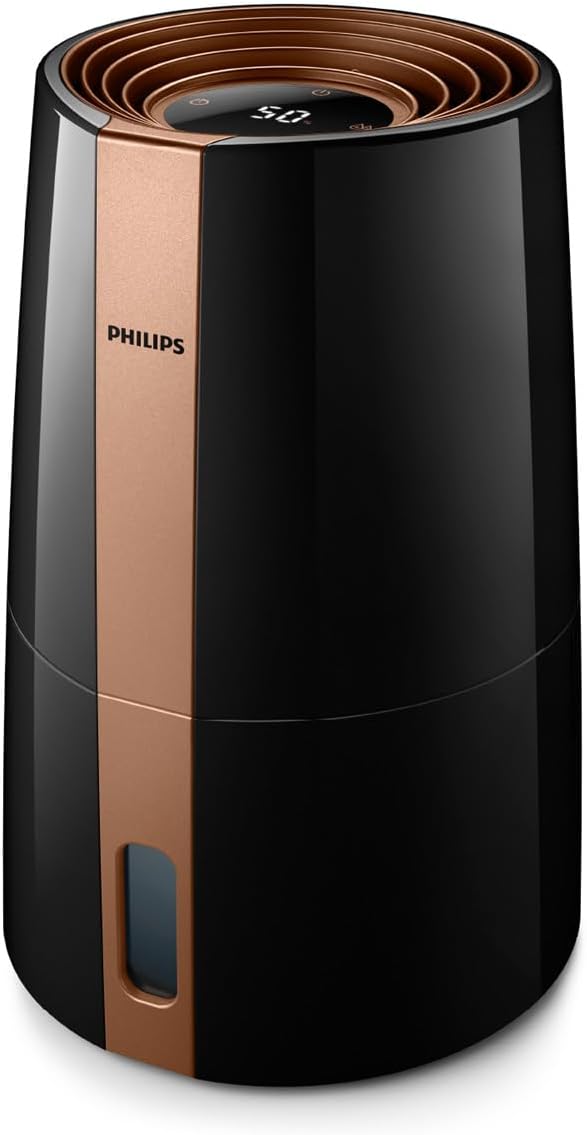
Philips Series 3000 HU3918/10
The most premium option here. It uses hygienic NanoCloud technology to clean the air as well as humidify it, holds 3 litres and is designed for rooms of up to 45 m², drawing 25 W. Amazon UK's listing states it spreads 99% less bacteria and offers three humidity levels.
What sets it apart is the finish and the control: a quiet night mode, automatic regulation, easy cleaning and handling, and a display that shows humidity and other readings in real time so you are not guessing. The obvious criticism is capacity — for this money, a tank larger than 3 litres would be reasonable, and both the Winix and the BreezeCare give you far more water for less. It was £179.99 on Amazon UK when we checked on 2 August 2026, with only one unit left in stock, so treat that figure as a snapshot. Check the price on Amazon UK or search on Amazon US
Which Type Should You Buy?
Humidifiers split broadly into cool and warm. Warm-mist models heat the water in the tank with electric elements until it turns to vapour. They tend to be small, carry a low risk of releasing pathogens because of how they work, and add a little warmth to the room — but be careful with small children around, since they can burn.
Evaporative models, a cool-mist type, use a filter and a fan to push water vapour into the air. Temperature is not a concern, but noise is, because of the fan. They are usually cheap, they work best with distilled water, and they need relatively frequent maintenance and filter changes.
Ultrasonic models, also cool mist, use a vibrating diaphragm to atomise the water, generally distilled or bottled. They stand out for being silent, highly effective, cheap to run and low-maintenance, which is why most of the picks above use this method. Dual units simply give you warm or cool vapour depending on what you need. Beyond those, some humidifiers add air-purifying technology — ozonisers, ion-exchange resins and other filters — to cut microorganisms and bad smells.
How To Choose
Prices in this category run from a little over the cost of a takeaway to well beyond a few hundred, so a handful of criteria matter more than the badge.
Tank size and autonomy. The tank is what the machine draws from, and once it is empty the humidifier stops working until you refill it. The most basic and compact units carry 300 - 500 ml; the largest sit around 5 litres and will keep going all day.
Humidification capacity. This is the flow of water it can put into the air, measured as volume per unit of time. The higher the figure, the faster it adjusts a room's humidity — and in practice it helps to have several levels rather than one fixed output.
Maximum recommended area. Because flow rates are abstract, many models simply state the square metres they are built for. It is the quickest way to know whether a unit will cope with your room.
With or without a hygrometer. Found on more premium models, this measures ambient humidity and lets the machine adjust itself automatically, so you set a target and the humidifier works towards it instead of you managing the mist by hand.
Timer and scheduling. Simpler and mid-range models can run for a set period and switch themselves off, provided there is water in the tank.
Cleaning and maintenance. Over time, moisture in the tank combined with warmth and dirt can turn it into a breeding ground for microorganisms. Look for units with an easy cleaning system and antibacterial treatment, and use distilled water where the instructions call for it.
Frequently Asked Questions
What humidity level should I aim for at home? Between 40 and 60% relative humidity. In winter that pairs with a temperature of 21-23 ºC and 40-50% humidity; in summer, 23-25 ºC and 45-60%.
Is a humidifier the same as a dehumidifier? No — they do opposite jobs. A dehumidifier removes moisture from a damp home; a humidifier adds it to a dry one. Buying the wrong one makes the problem worse.
Why do humidifiers ask for distilled water? Evaporative and ultrasonic models generally recommend distilled or bottled water. It reduces the mineral residue and helps keep the tank from becoming a source of microorganisms.
Which is quietest? Ultrasonic models. They atomise water with a vibrating diaphragm rather than a fan or a heating element, which is why the LEVOIT here is rated at 28dB.
How big a tank do I actually need? Match it to the room and how long you want it to run. A 300 ml unit suits a bedside table for a few hours; 3 litres covers a full night; 6 to 7.5 litres is for large or very dry spaces where refilling daily would be a chore.
If cleaner air is as much of a priority as moisture, several of these overlap with our best air purifiers guide, which covers filtration in more depth.