Smart bulbs are sold on colours and voice control, but the specification that decides whether a room is properly lit is the same one that matters for any LED: real lumens. And there is a simple way to estimate it.
Real lumens ≈ watts × 70. So a 12 W LED delivers roughly 840 lumens — enough to replace a traditional 60 W incandescent bulb. The underlying efficiency figure typically runs between 40 and 90 lumens per watt, which is why the multiplier is an approximation rather than a promise.
How much light each room needs
Ceiling height and beam angle both matter, but this table is a good working approximation, given in lux (lumens per square metre) measured 80 cm from the floor:
| Room |
Recommended |
| Kitchen |
500 lx |
| Dining room |
300 lx |
| Living room |
200 lx |
| Bathroom |
200 lx — 500 lx at the mirror |
| Bedroom |
150 lx — 500 lx in a study area |
Beam angle finishes the calculation: a 40-degree bulb throws a tightly localised pool of light, while 80 to 120 degrees covers far more surface.
Colour, dimming and why LED quality shows
For bulbs that do not change colour, read the colour temperature: around 3,000 K is warm white, 4,500 K is pure white, and 5,800 K is cool white.
Most smart bulbs dim, and this is where cheap LEDs betray themselves — with poor-quality LEDs the dimming progression is not continuous, so you get steps and flicker instead of a smooth fade. The same applies to RGB bulbs: the LED quality determines whether the colours look true.
The decision that shapes everything: Wi-Fi or ZigBee
Smart bulbs are ordinary LED bulbs with connectivity added, and that connectivity is the main difference between one bulb and another — it is what determines cross-brand compatibility.
Wi-Fi bulbs connect straight to your router and are controlled from a phone app with nothing else to buy. That is simple and efficient if you only want a couple of fittings.
ZigBee (and Z-Wave) bulbs need a hub or bridge as an intermediary. In exchange you can control far more fittings effectively and add switches, plugs and sensors — and because fewer devices talk directly to the router, there is less interference.
Neither is better in the abstract. The honest framing: buying one or two bulbs for atmosphere and colour points to Wi-Fi; building a whole automated home points to a ZigBee ecosystem.
Then check the ecosystem properly before buying: whether the model integrates with third-party products, with automation services such as IFTTT, and with the voice assistant you actually use — Siri, Alexa or Google Assistant.
The brands
Cheapest route — Xiaomi Mi LED Smart Bulb Essential. If price is the only criterion, this is the pick: an RGB bulb with dimming that connects over Wi-Fi, so no bridge or additional device is required. It works with Alexa, Google Assistant and Siri via HomeKit, and supports IFTTT routines. The catch is structural: because Xiaomi uses Wi-Fi and Philips uses ZigBee, it is not natively compatible with Philips Hue — you can only bridge the two through IFTTT rules. The listing specification is 9 W, E27, 950 lumens, 1700–6500 K.
Best ecosystem value — IKEA Trådfri. The strongest combination of integration and price, with a catalogue running from bulbs to LED panels, including RGB, dimmable, adjustable warm-or-cool white, and simple on-off connected lights. Its biggest asset is interoperability: thanks to ZigBee Light Link, Trådfri lighting can connect directly to a Philips Hue Bridge provided the product's software is version 1.2.x or later — older stock needs updating first using a Trådfri gateway and app. IKEA's own support confirms its smart lighting works with Apple HomeKit and Amazon Alexa given a Trådfri gateway, and with Google Assistant and Google Home. The range also includes sensors, remotes and plugs, so an entire starter system can be assembled in one shop. Its weakness is limited personalisation. Availability note: Trådfri is sold through IKEA's own UK stores and website rather than the usual retailers, so we link no third-party listing for it.
Best broad compatibility — Trust Smart Home. A domotics line whose appeal is compatibility, price and catalogue breadth — its bulbs work with Philips Hue and other ZigBee-ecosystem brands including Osram Lightify and IKEA Trådfri. One firm exclusion: they do not work with Siri, so Apple households should look elsewhere. A typical model is a 9 W, E27, 806-lumen warm white bulb.
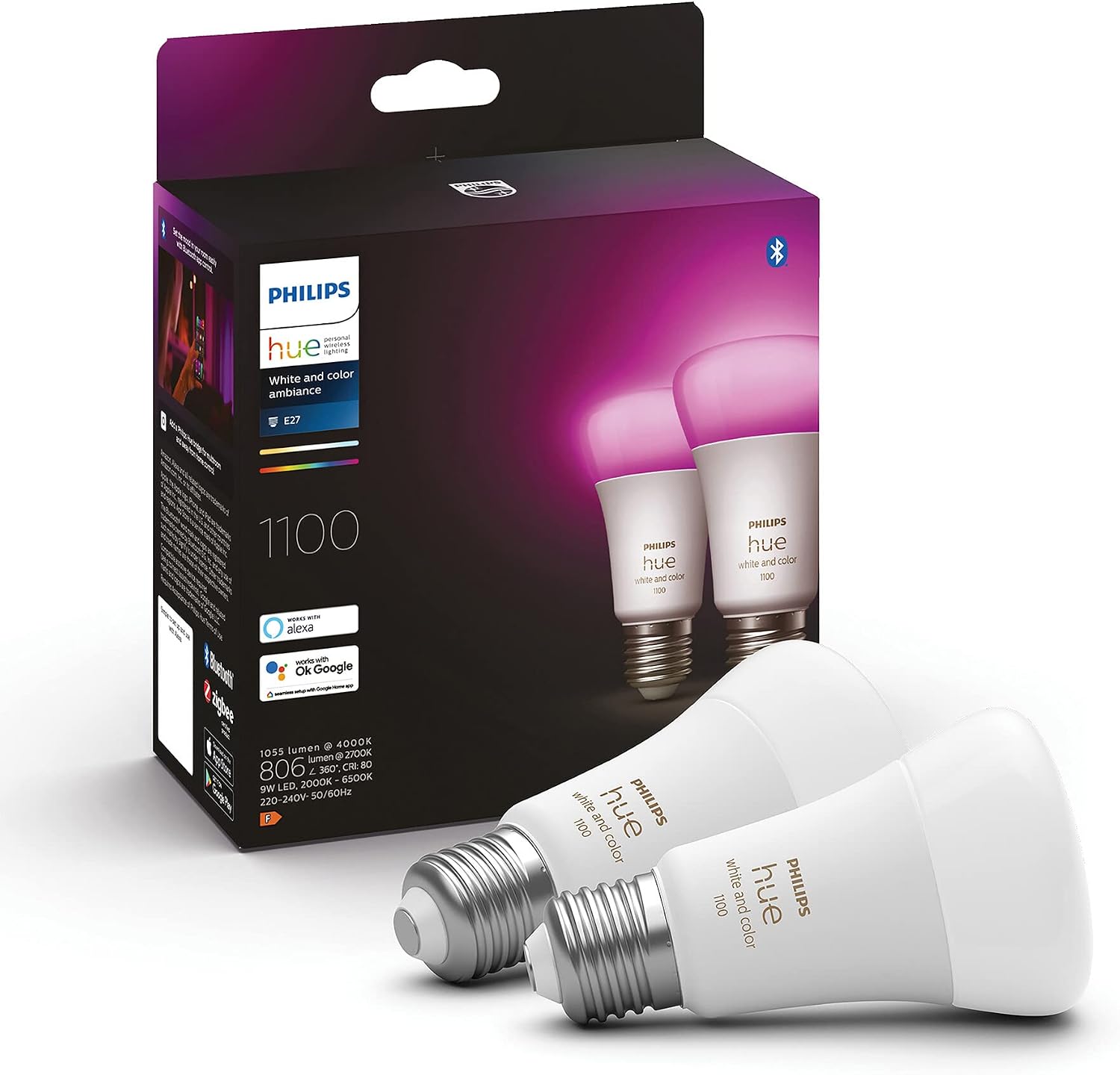
The automation standard — Philips Hue. Where the plan is to automate the house progressively, adding elements over time, Hue is the reference ZigBee choice. UK listings include the White and Colour Ambiance E27 line at 1,100 lumens with Bluetooth alongside bridge control.
Lidl Smart Home — not currently available here. The field rates its frequent offers, complete domotics system and affordability, with the limitation that its bulbs work only with Google Assistant. However, a check of Lidl's UK site returned no matching smart-bulb products, so treat this as a European recommendation that UK readers cannot currently act on. We link nothing for it.
Before you buy
Four questions. How many fittings, eventually? One or two means Wi-Fi and no hub; a whole house means ZigBee and a bridge. Which assistant do you actually use? One brand here excludes Siri entirely, another needs IFTTT to reach Hue. What are the real lumens? Multiply watts by about 70, then check the room table. And will you dim these often? — that is where cheap LEDs show steps and flicker.
Our best smart plugs guide covers the sockets, and our best smart speakers guide the voice control.
Research sources
Sources recorded for this page are linked below. Reported third-party testing belongs to the original publisher; it is not testing performed by Truthful Reviews.